 language
 english


Circuit Card Assembly Testing Guide for Reliable Manufacturing
Circuit card assembly testing helps you know whether a finished board is truly ready for use. It checks soldering quality, component placement, electrical performance, documentation, and final inspection results.
Best Technology supports circuit card assembly projects for industrial control, medical electronics, automotive electronics, communication equipment, LED systems, power electronics, aerospace-related products, and other electronic applications that require stable quality and clear production traceability.
For RFQ, Gerber review, BOM checking, or assembly quotation, pls feel free to contact us via sales@bestpcb.vn.
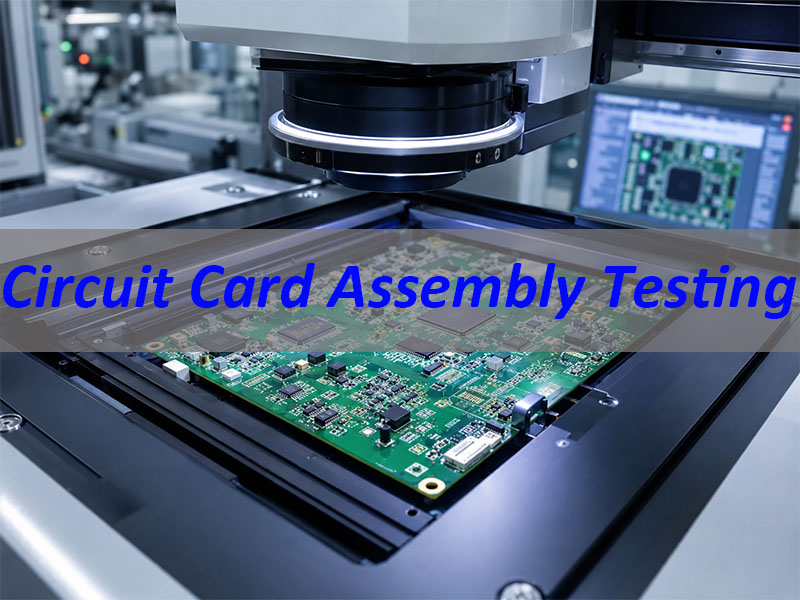
What Is Circuit Card Assembly Testing?
Circuit card assembly testing is the inspection and verification process used after components are assembled onto a printed circuit board. It checks whether the assembled board meets the required electrical, mechanical, soldering, and functional standards.
A complete testing process may include:
- Visual inspection
- AOI inspection
- X-ray inspection
- Solder joint inspection
- Continuity testing
- ICT testing
- Functional testing
- Programming
- Final quality inspection
- Packaging inspection
For customers, the purpose is simple: the board should not only look correct. It should work correctly in the final product.
At Best Technology, circuit card assembly testing is integrated with PCB manufacturing, component sourcing, SMT assembly, through-hole assembly, and final quality control. This helps reduce communication gaps between fabrication, assembly, and testing.
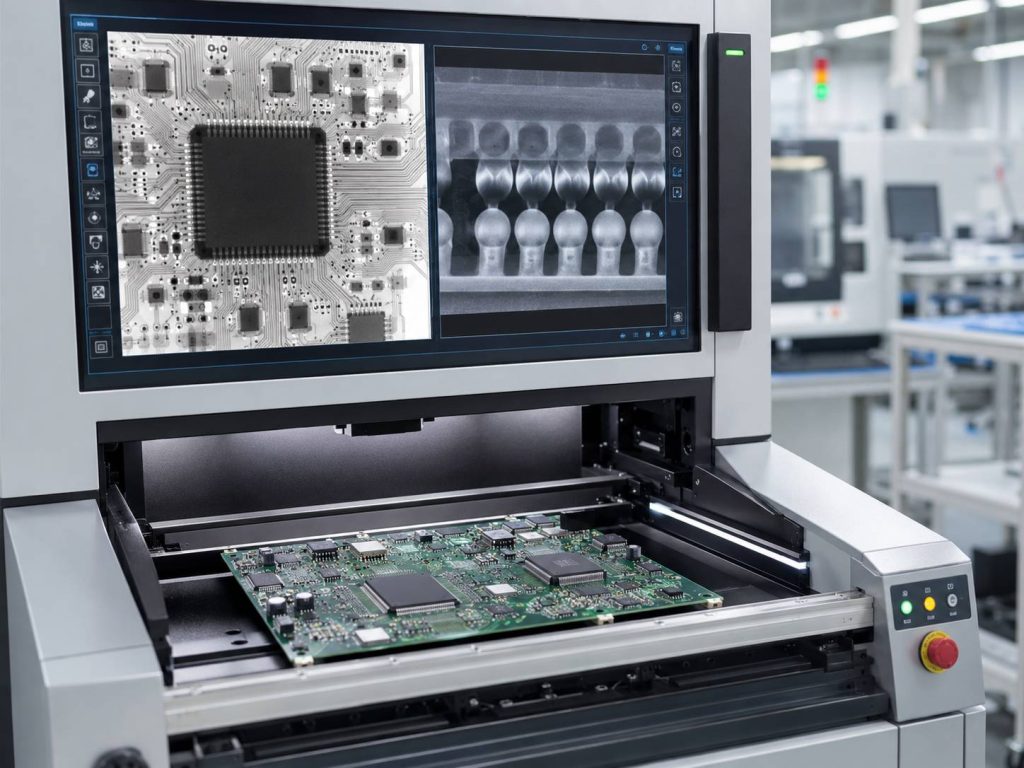
Why Is Testing Important in Circuit Card Assembly?
Testing is important because many defects cannot be found by appearance alone. A circuit card assembly may look clean, but hidden solder issues, wrong polarity, insufficient solder, poor component placement, or BGA defects can still affect product performance.
For engineers and buyers, testing helps confirm:
- Whether components are mounted in the correct position
- Whether solder joints are acceptable
- Whether fine-pitch ICs, BGAs, QFNs, and connectors are assembled properly
- Whether the board can pass electrical verification
- Whether the assembly matches the BOM, Gerber, pick-and-place file, and drawings
- Whether the product is ready for shipment or further system integration
This is why a reliable circuit card assembly supplier should not only provide assembly service. The supplier should also provide inspection records, testing support, engineering feedback, and quality control throughout production.
What Tests Are Commonly Used for Circuit Card Assembly?
Different projects require different test methods. A simple LED control board may only need AOI and functional testing, while a medical, automotive, or industrial control board may require a more complete test plan.
Common circuit card assembly testing methods include:
| Test Method | What It Checks | Common Use |
|---|---|---|
| Visual Inspection | Component direction, obvious solder defects, board cleanliness | All PCBA projects |
| AOI Inspection | Missing parts, offset parts, polarity, solder shape | SMT assembly |
| X-Ray Inspection | Hidden solder joints under BGA, QFN, LGA, and bottom-terminated parts | High-density assemblies |
| ICT Testing | Opens, shorts, resistance, capacitance, basic circuit connection | Medium to high-volume production |
| Functional Testing | Whether the board works according to product requirements | Finished assemblies |
| Programming | MCU, IC, or memory firmware loading | Smart devices and control boards |
| Final QC Inspection | Appearance, labeling, packaging, quantity, documentation | Before shipment |
For many customers, the most valuable combination is AOI + X-ray + functional testing + final inspection. This provides stronger confidence before the boards are shipped.
What Is Final Inspection in Circuit Card Assembly Testing?
Final inspection is the last quality checkpoint before packaging and delivery. It confirms that the completed circuit card assembly meets the order requirements and is ready for customer use.
Final inspection usually checks:
- Board appearance
- Component placement
- Solder joint quality
- Connector condition
- Label and marking accuracy
- Test result confirmation
- Quantity verification
- Packaging protection
- Customer-specific requirements
For export orders, final inspection is especially important because it helps reduce receiving-side issues. A circuit card assembly may pass functional testing, but if packaging, labeling, or documentation is incorrect, it can still delay the customer’s production schedule.
At Best Technology, final inspection is treated as part of the manufacturing process, not just a last-minute check.
What Board Types Does Best Technology Support for Circuit Card Assembly?
Best Technology supports different circuit card assembly projects based on PCB structure, material, copper weight, thermal demand, and product requirements. This helps customers match the right board type before assembly and testing.
| Board Type | Typical Use |
|---|---|
| Rigid PCB Assembly | Standard electronic control boards |
| Multilayer PCB Assembly | Compact circuits with higher routing density |
| HDI PCB Assembly | Fine-pitch ICs, BGA, and dense SMT layouts |
| Flexible PCB Assembly | Bendable and lightweight electronic products |
| Rigid-Flex PCB Assembly | Compact devices with limited internal space |
| High-Tg FR4 PCB Assembly | Products requiring better thermal resistance |
| Heavy Copper PCB Assembly | High-current and power circuit designs |
| Aluminum PCB Assembly | LED, power, and heat-dissipation applications |
| Copper Substrate PCB Assembly | High-power thermal management projects |
| Ceramic PCB Assembly | High-thermal and special-performance circuits |
| Rogers / High-Frequency PCB Assembly | RF, antenna, microwave, and communication boards |
Best Technology can support these board types from PCB fabrication to circuit card assembly preparation, helping customers build a stronger foundation for later inspection, testing, and final quality control.
Circuit Card Assembly Testing and Manufacturing Capabilities
Best Technology provides circuit card assembly manufacturing with testing support for prototype, small-batch, and production projects.
Core capabilities include:
PCB Fabrication
- Single-sided, double-sided, and multilayer PCB
- HDI PCB
- Rigid-flex PCB
- High-frequency PCB
- Metal core PCB
- Ceramic PCB
- Heavy copper PCB
- Controlled impedance PCB
Component Sourcing
- BOM review
- Component availability checking
- Alternative component suggestions when needed
- Support for active, passive, connector, IC, module, and electromechanical parts
PCB Assembly
- SMT assembly
- Through-hole assembly
- Mixed technology assembly
- BGA, QFN, DFN, fine-pitch IC assembly
- Connector and cable-related assembly
- Manual soldering for special components
- Prototype and batch assembly
Testing and Inspection
- AOI inspection
- X-ray inspection
- Visual inspection
- Functional testing according to customer test procedure
- Programming support
- Final quality inspection
Engineering Support
- DFM review
- BOM checking
- PCB stack-up support
- Soldering process suggestions
- Assembly risk review
- Quality feedback before mass production
This makes Best Technology suitable for customers who want one supplier to manage PCB fabrication, circuit card assembly, testing, and delivery coordination.
Applications Using Circuit Card Assembly
Circuit card assemblies are used in almost every electronic product. The key difference is that each application has its own reliability, documentation, and testing requirements.
Best Technology supports circuit card assembly for applications such as:
| Application Area | Common Requirements |
|---|---|
| Industrial Control | Stable soldering, long-term reliability, connector strength, functional testing |
| Medical Electronics | Clean assembly, traceability, documentation, controlled quality process |
| Automotive Electronics | Thermal reliability, vibration resistance, process consistency |
| Communication Equipment | Signal integrity, impedance control, RF material support |
| Power Electronics | Heavy copper, thermal management, high-current design support |
| LED Lighting | Aluminum PCB, copper substrate PCB, thermal path control |
| Aerospace-Related Electronics | High reliability, documentation, strict inspection process |
| Consumer and Smart Devices | Compact layout, SMT precision, fast prototype support |
For customers, the best supplier is not always the one that only assembles boards quickly. The better choice is a supplier that understands the application environment and adjusts the manufacturing process accordingly.
Certifications for Circuit Card Assembly Manufacturing and Testing
Certifications help customers evaluate whether a supplier has a structured quality management system.
Best Technology works under quality systems commonly required for electronic manufacturing, including:
- ISO 9001 for general quality management
- ISO 13485 for medical device-related manufacturing quality control
- IATF 16949 for automotive electronics quality requirements
- AS9100D for aerospace-related quality management
- UL-related PCB manufacturing support where applicable
For customers in regulated or high-reliability industries, certifications are not just documents. They reflect whether the supplier can manage process control, traceability, inspection, corrective actions, and production consistency.
When sending an RFQ, customers can also ask Best Technology for production flow, inspection plan, and documentation support based on the project requirement.
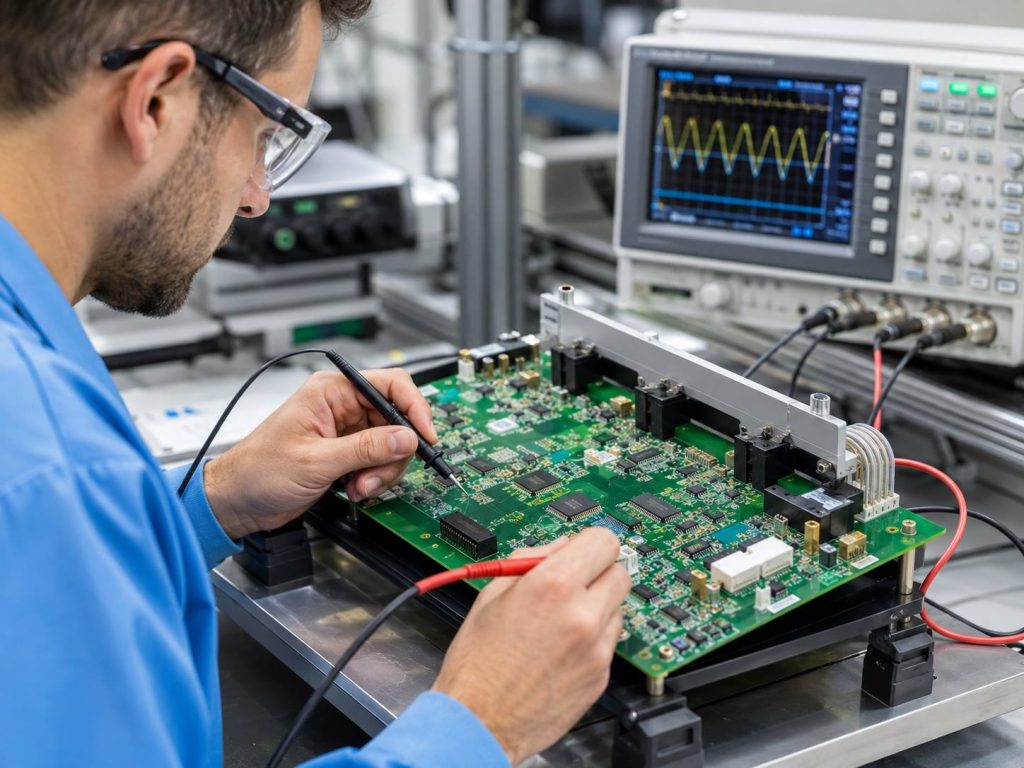
Case Study: Best Technology Circuit Card Assembly Manufacturing Project
Project Type: Circuit card assembly for electronic control equipment
Board Base: 4-layer FR4 TG150 PCB
Main Requirement: Stable PCB fabrication, assembly-ready panel design, and controlled testing before shipment
Best Technology Support: PCB fabrication, assembly preparation, inspection, testing support, and final quality control
Testing and Inspection Flow
| Stage | What Best Technology Checked |
|---|---|
| Before Assembly | Electrical test, board thickness, copper thickness, solder mask quality, ENIG surface finish |
| Via Quality Check | Resin plugged via quality, via flatness, via reliability for assembly |
| Panel Inspection | 12.7mm process edges, panel spacing, routing area, V-cut position |
| During Assembly | Component placement accuracy, soldering quality, polarity, connector position |
| After Assembly | AOI inspection, solder joint inspection, X-ray inspection if required |
| Final Testing | Functional testing based on customer test procedure |
| Final Inspection | Appearance, labeling, quantity, packaging, and shipment readiness |
Why This Case Matters
This project shows that circuit card assembly testing should start before components are mounted. A stable PCB base helps improve soldering quality, assembly accuracy, and final test reliability.
For customers who need PCB fabrication + circuit card assembly + testing + final inspection, Best Technology can manage the full process in one production flow.
Circuit Card Assembly Board Parameters
| Item | Specification |
|---|---|
| Board Type | 4-layer circuit card assembly board |
| Base Material | FR4 TG150 |
| Finished Thickness | 1.60mm ±10% |
| Copper Thickness | 1/1/1/1oz |
| Surface Finish | ENIG 1U |
| Solder Mask / Silkscreen | Green solder mask / White silkscreen |
| Via Process | Resin plugged vias |
| Panel Process Edge | 12.7mm process edges on all four sides |
| Panel Spacing | 2.3622mm |
| Short Side of Single Board | Routed opening |
| Long Side | V-cut |
| Testing Focus | Electrical test, via inspection, panel check, AOI, functional test, final inspection |
FAQs About Circuit Card Assembly Testing
Q1: What files are needed for circuit card assembly testing and manufacturing?
A1: Common files include Gerber files, BOM, pick-and-place file, assembly drawing, test procedure, firmware file if programming is required, and special inspection requirements.
Q2: Can Best Technology provide circuit card assembly with testing?
A2: Yes. Best Technology can support PCB fabrication, component sourcing, SMT assembly, through-hole assembly, AOI inspection, X-ray inspection, functional testing, and final inspection.
Q3: Is functional testing always required?
A3: Functional testing is recommended when the board has power circuits, ICs, communication interfaces, sensors, firmware, or control functions. For simple boards, AOI and visual inspection may be enough, depending on the application.
Q4: Can X-ray inspection be used for BGA and QFN components?
A4: Yes. X-ray inspection is commonly used to check hidden solder joints under BGA, QFN, LGA, and other bottom-terminated components.
Q5: Does Best Technology support prototype and production circuit card assembly?
A5: Yes. Best Technology supports prototype, small-batch, and production circuit card assembly projects.
Q6: Can Best Technology help check the BOM before assembly?
A6: Yes. BOM checking can help identify package mismatch, obsolete parts, sourcing risks, polarity issues, and possible alternative components.
Q7: What industries does Best Technology support?
A7: Best Technology supports circuit card assembly for industrial control, medical electronics, automotive electronics, communication equipment, LED systems, power electronics, and other electronic applications.
Q8: How can I request a quote?
A8: Send your Gerber files, BOM, pick-and-place file, quantity, and testing requirements to sales@bestpcb.vn. Best Technology will review the project and provide manufacturing feedback with quotation support.