 language
 english


Advanced Assembly PCB Services for High-Quality Electronics Manufacturing
Are you searching for advanced assembly PCB solutions that improve manufacturing quality and shorten production time? Modern electronic products require stable electrical connections, compact PCB layouts, and reliable assembly performance, making advanced PCB assembly increasingly important in many industries.
Today, advanced assembly PCB services support high-density PCB designs, automated SMT production, and precision component mounting. From prototype development to mass production, these technologies help improve manufacturing consistency, reduce assembly defects, and increase long-term product reliability.
What Is Advanced Assembly PCB?
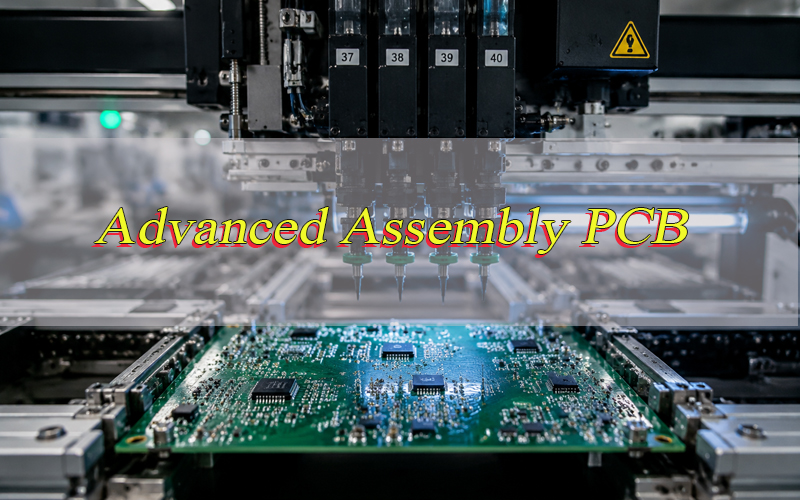
Advanced assembly PCB refers to modern PCB assembly processes that use automated production equipment, precision soldering technology, and strict quality inspection systems to manufacture reliable electronic products.
Compared with traditional assembly methods, advanced PCB assembly supports fine-pitch components, BGA packages, multilayer PCBs, and high-speed signal applications more effectively. It is widely used in automotive electronics, industrial control systems, medical devices, and communication equipment.
Modern advanced PCB assembly also includes PCB fabrication, component sourcing, AOI inspection, X-ray testing, and functional verification. These processes help improve soldering quality, electrical stability, and manufacturing efficiency.
Why Is Advanced Assembly PCB Important for Modern Electronics?
Modern electronics are becoming smaller, faster, and more complex. Traditional assembly methods often cannot meet the requirements of high-density PCB layouts, miniaturized components, and stable signal transmission.
Advanced PCB assembly improves component placement accuracy, solder joint reliability, and overall production consistency through automated SMT equipment and intelligent inspection systems. This helps reduce manufacturing defects and improve product stability.
For automotive, industrial, medical, and communication electronics, long-term reliability and stable electrical performance are extremely important. Advanced PCB assembly technologies help products operate more safely and reliably in demanding environments.
In addition, advanced PCB fabrication for high quality electronics circuit board assembly supports better heat dissipation, impedance control, and high-speed signal integrity, which are essential for modern electronic devices.
What Are the Main Types of Advanced PCB Assembly?
Different products require different assembly methods. Modern PCBA manufacturing usually combines several advanced assembly technologies to meet product requirements.
SMT Assembly
- Surface mount technology is widely used for compact electronic products.
- Supports high-speed automated placement.
- Suitable for multilayer and miniaturized PCB designs.
Through-Hole Assembly
- Used for components requiring strong mechanical connections.
- Common in industrial power systems and heavy-duty equipment.
- Often combined with SMT assembly.
Mixed Technology Assembly
- Combines SMT and through-hole technologies.
- Suitable for complex electronic products.
- Improves design flexibility.
BGA Assembly
- Supports high-pin-count integrated circuits.
- Requires precise soldering and X-ray inspection.
- Common in advanced computing and communication products.
Flexible PCB Assembly
- Used for wearable devices and compact electronics.
- Supports bending and space-saving designs.
- Requires controlled assembly processes.
How Does Advanced PCB Fabrication Improve Assembly Quality?
Advanced PCB fabrication directly affects assembly performance and product reliability. High-quality PCB manufacturing helps reduce defects during the assembly process.
Improved Hole Accuracy
- Precision drilling improves component alignment.
- Reduces soldering defects.
- Supports high-density PCB structures.
Better Copper Thickness Control
- Ensures stable electrical conductivity.
- Improves current handling capability.
- Supports thermal management.
Accurate Solder Mask Registration
- Helps prevent solder bridging.
- Improves assembly precision.
- Supports fine-pitch component mounting.
Controlled Impedance Manufacturing
- Essential for high-speed signal transmission.
- Improves signal stability.
- Reduces electromagnetic interference.
Stable Surface Finishes
- Improves solderability.
- Extends PCB storage life.
- Supports reliable solder joints.
What Technologies Are Used in Advanced PCB Assembly Lines?
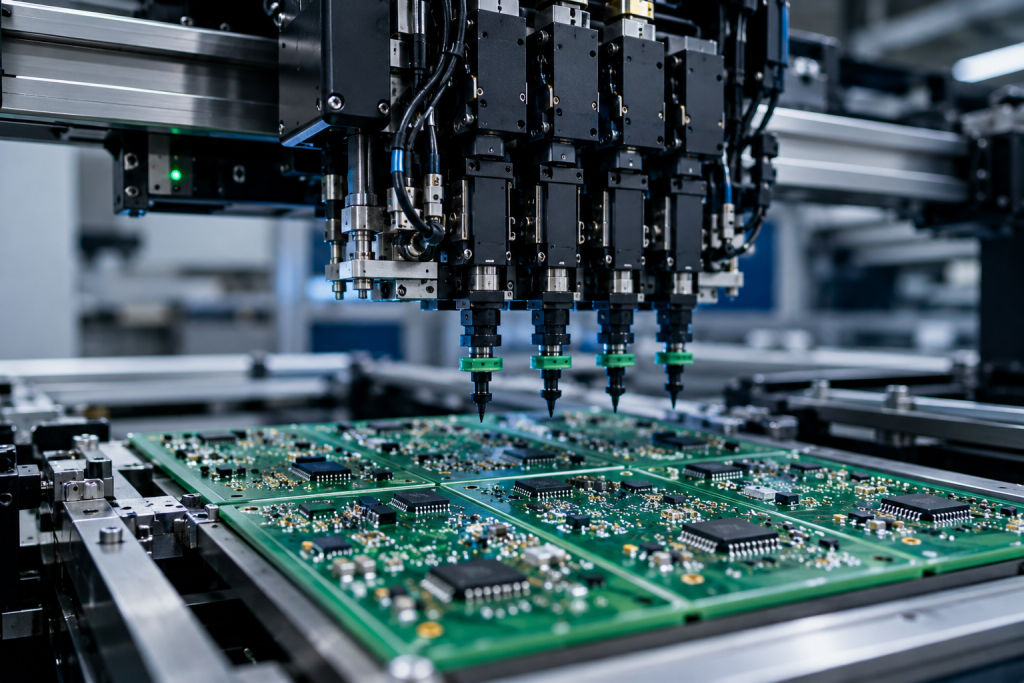
Modern PCB assembly lines use intelligent manufacturing equipment to improve efficiency and consistency.
Automated Pick and Place Machines
- Support high-speed component placement.
- Improve placement accuracy.
- Reduce manual operation.
SPI Inspection Systems
- Inspect solder paste quality before placement.
- Reduce soldering defects.
- Improve process stability.
Reflow Soldering Technology
- Provides controlled heating profiles.
- Improves solder joint quality.
- Supports lead-free assembly.
AOI Inspection
- Detects missing or incorrect components.
- Improves production quality.
- Supports fast defect identification.
X-Ray Inspection
- Used for hidden solder joints.
- Essential for BGA inspection.
- Improves assembly reliability.
MES Intelligent Manufacturing Systems
- Monitor production data in real time.
- Improve traceability.
- Help optimize production management.
How Does Automation Improve PCB Assembly Efficiency?
Automation plays an important role in modern PCB manufacturing. It improves production speed, assembly accuracy, and manufacturing consistency.
Faster Production Speed
- Automated systems support continuous production.
- Reduce assembly cycle time.
- Improve manufacturing capacity.
Improved Accuracy
- Machines provide precise component placement.
- Reduce manual alignment errors.
- Support miniaturized PCB designs.
Lower Defect Rates
- Automated inspection reduces production mistakes.
- Improves solder joint consistency.
- Helps maintain stable product quality.
Better Production Traceability
- Digital systems record production data.
- Improve quality management.
- Support long-term product tracking.
Reduced Manufacturing Costs
- Improves labor efficiency.
- Reduces material waste.
- Supports large-volume production.
What Are the Steps in Advanced PCB Board Assembly?
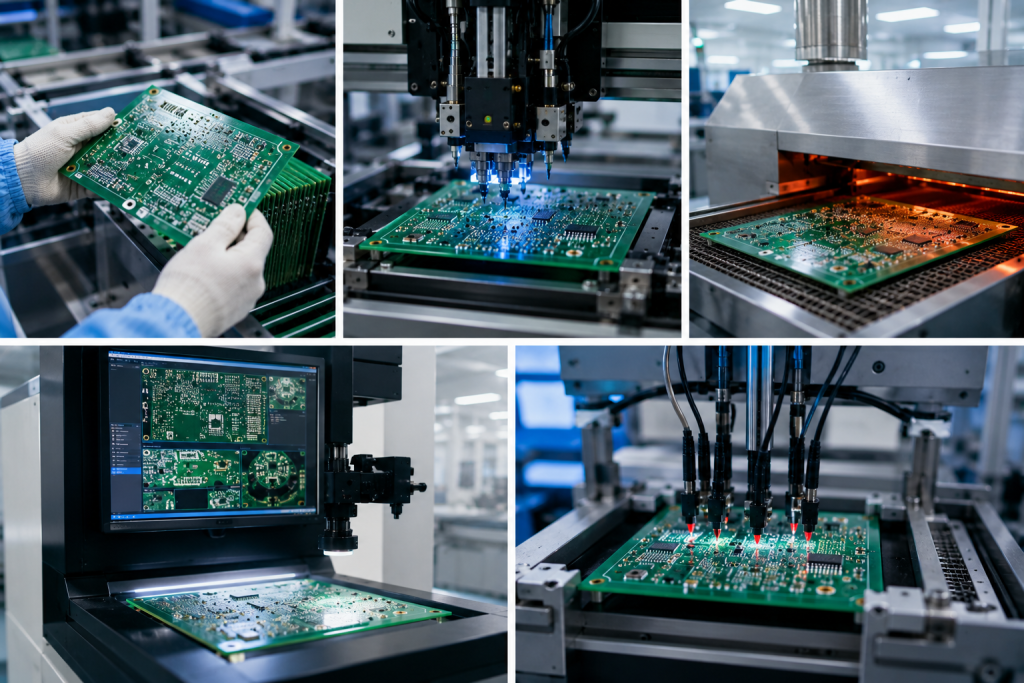
Modern advanced PCB board assembly follows a controlled manufacturing process to ensure stable electrical performance, reliable soldering quality, and long product life. Each production stage affects the final PCBA quality, especially for multilayer and high-density electronic products.
Step 1: PCB Material Inspection
- PCB panels are inspected before assembly begins.
- Manufacturers check PCB dimensions, hole accuracy, surface finish, and board cleanliness.
- Material verification helps reduce assembly defects and improves production stability.
Step 2: Component Preparation
- Electronic components are checked according to the BOM and assembly drawings.
- Production teams verify polarity direction, package size, and component condition.
- Moisture-sensitive components are stored in controlled environments to maintain soldering reliability.
Step 3: Solder Paste Printing
- Solder paste is printed onto PCB pads using precision steel stencils.
- Proper solder paste thickness is important for stable solder joints.
- SPI inspection systems help verify printing accuracy and consistency.
Step 4: Component Placement
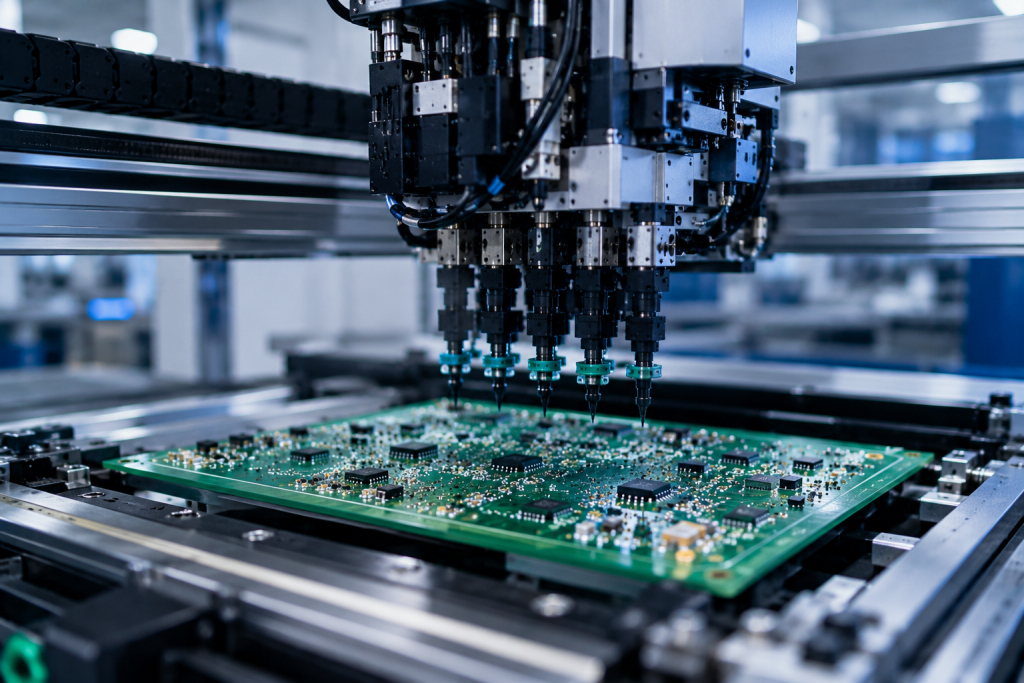
- Automated SMT machines place components onto the PCB at high speed.
- Vision alignment systems improve placement precision for small and fine-pitch components.
- Accurate placement helps improve electrical performance and assembly yield.
Step 5: Reflow Soldering
- The PCB passes through a controlled reflow oven after component placement.
- Heat melts the solder paste to create stable electrical connections.
- Controlled temperature profiles help reduce soldering defects and component damage.
Step 6: AOI and X-Ray Inspection
- AOI systems inspect missing components, polarity errors, and soldering defects.
- X-ray inspection is used for hidden solder joints such as BGA and QFN packages.
- These inspection methods help improve overall assembly reliability.
Step 7: Functional Testing
- Functional testing verifies electrical performance and product operation.
- Common tests include power testing, signal verification, and communication checks.
- Testing helps identify hidden defects before shipment.
Step 8: Cleaning and Final Assembly
- Flux residue and contaminants are removed when necessary.
- Some products receive conformal coating for moisture and dust protection.
- Final assembly processes are completed before packaging.
Step 9: Packaging and Shipment
- PCBAs are labeled with traceability information and inspection records.
- Anti-static packaging helps protect products during transportation.
- Proper packaging improves shipment safety and storage reliability.
What Quality Standards Are Required for Advanced PCB Assembly?
Quality standards are important in advanced PCB assembly because they affect soldering reliability, electrical performance, and product stability. Strict quality control helps reduce manufacturing defects and improve assembly consistency.
IPC Standards
- IPC-A-610 defines PCB assembly acceptance standards.
- IPC J-STD-001 focuses on soldering process requirements.
- Helps improve solder joint quality and assembly reliability.
ISO9001 Quality Management
- Standardizes production management processes.
- Improves manufacturing consistency and traceability.
- Commonly used in global electronics manufacturing.
RoHS Compliance
- Restricts hazardous substances in electronic products.
- Supports lead-free PCB assembly processes.
- Required in many international markets.
ESD Protection
- Prevents electrostatic damage to electronic components.
- Uses anti-static equipment and controlled production areas.
- Important for sensitive IC components.
AOI and X-Ray Inspection
- AOI checks soldering defects and component placement.
- X-ray inspection verifies hidden solder joints such as BGA packages.
- Helps improve assembly quality and reliability.
Functional Testing
- Verifies electrical performance before shipment.
- Includes power testing and signal testing.
- Helps reduce product failure risks.
Traceability Control
- Records production and inspection data.
- Improves quality management and product tracking.
- Commonly used in automotive and industrial electronics.
Which Industries Need Advanced Assembly PCB Services?
Advanced PCB assembly is widely used across many industries due to increasing electronic complexity.
Automotive Electronics
- ADAS systems.
- Automotive control modules.
- Battery management systems.
Industrial Automation
- Motion control equipment.
- Sensor systems.
- Industrial communication devices.
Medical Electronics
- Monitoring devices.
- Diagnostic equipment.
- Portable medical systems.
Telecommunication Equipment
- High-frequency communication systems.
- Network devices.
- Signal transmission modules.
Consumer Electronics
- Smart wearable devices.
- Mobile electronics.
- Smart home systems.
Aerospace and Defense
- Radar systems.
- Navigation equipment.
- Mission-critical electronics.
How to Choose Reliable Advanced PCB Assembly Companies?
Choosing the right PCB assembly company is important because it directly affects product quality, production efficiency, and shipment reliability. A professional supplier should provide stable manufacturing capability, strict quality control, and fast technical support throughout the entire PCBA process.
Review Manufacturing Experience
- Choose manufacturers with experience in multilayer PCB, BGA assembly, fine-pitch components, and high-density PCB projects.
- Experienced suppliers can identify potential production problems earlier and reduce assembly risks.
- It is also helpful to check whether the company has experience in automotive, industrial, medical, or communication electronics.
Check Production Equipment and Assembly Capability
- Advanced SMT production lines improve placement accuracy and production speed.
- AOI, SPI, and X-ray inspection systems help detect soldering defects and hidden connection issues.
- Suppliers with automated equipment usually provide more stable assembly quality and better consistency for mass production.
Verify Quality Standards and Inspection Processes
- Reliable PCB assembly companies normally follow IPC, ISO9001, and RoHS standards.
- Functional testing, AOI inspection, flying probe testing, and X-ray inspection help improve product reliability.
- Strong quality management systems reduce defect rates and improve shipment stability.
Evaluate PCB Fabrication and Component Sourcing
- Suppliers that support both PCB fabrication and assembly can better control overall production quality.
- Stable component sourcing channels help avoid counterfeit or poor-quality electronic parts.
- Good material management also helps reduce production delays caused by component shortages.
Confirm Delivery Capability and Production Flexibility
- A reliable supplier should support both rapid prototyping and large-volume production.
- Fast turnaround capability is important for urgent projects and product development schedules.
- Flexible production planning helps improve long-term cooperation efficiency.
Assess Technical Support and Communication Efficiency
- Fast communication helps solve technical questions quickly during production.
- Suppliers that provide DFM analysis can help optimize PCB layout and assembly before manufacturing starts.
- Clear production updates and responsive support improve project management efficiency.
Focus on Long-Term Value Instead of Only Price
- Extremely low pricing may lead to unstable quality or delayed delivery.
- Stable assembly quality, reliable testing capability, and consistent production support are more important for long-term projects.
- Choosing a professional PCB assembly partner can help reduce total manufacturing costs over time.
Why Choose Best Technology for Advanced Assembly PCB Manufacturer?
Choosing the right PCB assembly partner can help reduce production risks, improve product reliability, and shorten delivery time. EBest focuses on providing stable PCB fabrication and PCBA assembly services that help customers complete projects more efficiently and with better quality.
One-Stop PCB and PCBA Service
- From PCB fabrication and component sourcing to SMT assembly and final assembly, all processes are completed in one place.
- This helps reduce communication problems, shorten lead time, and improve production efficiency.
Strong Manufacturing Capability
- Supports SMT, through-hole, BGA, flex PCB, ceramic PCB, and mixed assembly projects.
- Compatible with 01005 small components and 0.25mm BGA pitch assembly for complex PCB designs.
- Suitable for both prototypes and mass production.
Faster Delivery for Urgent Projects
- Prototype lead time can be as fast as 1–5 days.
- Urgent PCB orders can be shipped within 24 hours.
- Flexible production scheduling helps customers speed up product development.
Stable Quality Control
- Uses AOI, X-ray inspection, and functional testing to improve assembly reliability.
- Certified with ISO9001, IATF16949, ISO13485, AS9100D, RoHS, and UL standards.
- Strict inspection processes help reduce manufacturing defects and shipment risks.
Reliable Component Supply
- Dedicated sourcing team supports stable electronic component purchasing.
- Helps reduce component shortages and counterfeit material risks.
- Supports cost-effective procurement for PCB assembly projects.
Support for Multiple Industries
- Manufacturing experience in automotive, industrial, medical, communication, and consumer electronics products.
- Better understanding of reliability and quality requirements for different applications.
Additional Manufacturing Support
- Provides box build assembly, CNC machining, injection molding, and sheet metal fabrication.
- Helps simplify complete electronic product manufacturing projects.
FAQs About Advanced PCB Assembly Services
Q1: Why do some PCB assemblies fail after long-term use?
A1: Many PCB failures are related to poor soldering quality, unstable materials, or insufficient testing during production. Reliable PCB assembly manufacturers usually use strict inspection processes and stable manufacturing controls to improve long-term product reliability.
Q2: Is low-cost PCB assembly always a good choice?
A2: Very low pricing may reduce manufacturing quality, testing processes, or material reliability. For industrial and high-performance electronics, stable production quality and reliable delivery are often more important than the lowest assembly cost.
Q3: Why are BGA components more difficult to assemble?
A3: BGA packages have hidden solder joints under the component, making visual inspection difficult. Advanced PCB assembly lines usually use precise temperature control and X-ray inspection to ensure soldering quality and electrical stability.
Q4: What problems can happen if solder paste printing is inaccurate?
A4: Incorrect solder paste volume may cause solder bridging, weak solder joints, or missing electrical connections. This is why many PCB assembly factories use SPI inspection systems before component placement.
Q5: Why is component sourcing important for PCB assembly quality?
A5: Unstable or low-quality electronic components can increase production defects and shorten product lifespan. Reliable PCB assembly companies usually work with stable supply chains to reduce counterfeit and damaged component risks.
Q6: Can one PCB assembly supplier support both prototypes and volume production?
A6: Yes. Many professional PCB assembly manufacturers support prototype development, pilot runs, and mass production. Using the same supplier can help maintain production consistency and reduce communication problems.
Q7: Why do some PCB projects require conformal coating?
A7: Conformal coating protects PCB assemblies from moisture, dust, chemicals, and temperature changes. It is commonly used in automotive electronics, industrial control systems, and outdoor electronic equipment.
Q8: What affects PCB assembly lead time the most?
A8: Lead time is usually affected by PCB complexity, component availability, assembly quantity, and testing requirements. Projects using special materials or hard-to-source components may require additional production time.
Conclusion
Modern electronics require stable performance, precise manufacturing, and reliable electrical connections. Advanced PCB assembly technologies help improve production quality, shorten manufacturing cycles, and support increasingly complex electronic products.
If you are looking for professional PCBA assembly services, EBest provides reliable PCB fabrication, SMT assembly, component sourcing, and full testing support for your projects. Contact our team today at sales@bestpcb.vn for fast and high-quality PCBA manufacturing solutions.