 language
 english


Electronics Assembly Traceability Requirements | End-to-End Visibility
Electronics Assembly Traceability Requirements are the backbone of quality control and supply chain integrity in modern manufacturing, ensuring that every component and process step in a PCB assembly can be tracked from origin to final product. This comprehensive guide explores the critical aspects of traceability, from data tracking to defect management, and explains how a robust system provides end-to-end visibility for secure and reliable electronics production.
Many customers face significant hurdles that compromise product reliability and project timelines. Let’s examine the most common pain points:
- Lost Component Histories: Inability to verify the origin, lot code, or date code of individual components, especially critical ICs and BGAs.
- Inefficient Defect Isolation: When a failure occurs, teams waste days or weeks manually tracing the fault to a specific batch, process, or material, delaying root cause analysis.
- Cumbersome Recall Management: Without granular data, product recalls become overly broad and costly, forcing the replacement of entire batches instead of targeted, affected units.
- Inconsistent Documentation: Receiving incomplete or generic test reports and certificates of conformity (CoC) that lack specific board-level traceability data.
- Supply Chain Black Box: Lack of visibility into the component supply chain, increasing the risk of using counterfeit, obsolete, or non-compliant parts.
The Best Technology Solution: Engineered Visibility from Start to Finish.
- End-to-End Digital Tracking: Every component, from SMDs to BGAs, is logged with its unique sourcing data (manufacturer, lot, date code) upon receipt, and this data is married to the specific PCB serial number throughout our SMT and assembly process.
- Automated Process Correlation: Our manufacturing execution system (MES) automatically links soldering profiles, AOI results, and test data (ICT, FCT) to each board’s unique identifier, enabling instant defect isolation to a specific process parameter.
- Granular Recall Enablement: Our traceability system allows for pinpoint recalls limited to specific production runs, shifts, or even component lots, drastically reducing the scope and cost of any corrective action.
- Comprehensive, Board-Specific Documentation: We provide detailed, per-lot traceability reports, including DFM analysis, x-ray inspection records for BGAs, and full material certifications, all referenced to your specific order and board serialization.
- Audited, Stable Supply Chain: We source components directly from authorized distributors like Digikey, Mouser, and Avnet, and maintain a stable supply chain for all electronic components. Our system verifies and records this provenance, giving you a clear, auditable trail.
Founded in 2006, Best Technology is a certified (ISO 9001, AS9100D, IATF 16949, ISO 13485, UL, RoHS) one-stop PCBA solution provider based in Vietnam. With 20 years of expertise, we specialize in turning complex electronics assembly challenges into reliable products. From advanced PCB assembly technology for rigid, flexible, and ceramic PCBs to full box build, our commitment is to quality assured by complete traceability. We empower our clients with end-to-end visibility, ensuring not just delivery, but reliability. For a consultation on your next SMT PCB assembly project, pls feel free to contact our team at sales@bestpcb.vn.
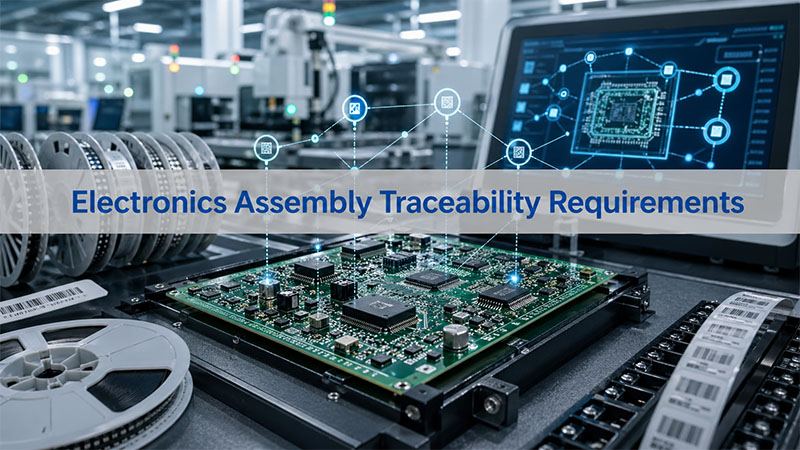
What Are Electronics Assembly Traceability Requirements?
Traceability in electronics assembly is the systematic capability to identify and document the history, application, and location of components, materials, and processes throughout the entire PCB assembly process. It creates a verifiable audit trail that links the final assembled board back to its constituent parts and production steps. This is fundamental for quality assurance, regulatory compliance, and supply chain management.
A robust traceability system typically tracks:
- Component Data: Manufacturer, part number, lot/batch code, date code, and country of origin.
- Material Data: PCB laminate type (e.g., FR4, Rogers, Al₂O₃ ceramic), copper weight, solder mask, and finish.
- Process Data: SMT program used, reflow soldering profile, operator ID, machine ID, and timestamps for each major step.
- Inspection & Test Results: Outcomes from AOI, X-ray, ICT, and Functional Test (FCT), all tied to the specific unit or batch.
Table: Key Data Points in a Traceability System
| Data Category | Specific Information Tracked | Purpose |
|---|---|---|
| Component | Supplier PN, Mfg. Lot #, Date Code | Counterfeit prevention, recall accuracy |
| PCB Fabrication | Panel ID, Material Batch, Layer Stack-up | Quality consistency, failure analysis |
| Assembly Process | SMT Line, Reflow Profile #, Operator | Process control, defect correlation |
| Quality | AOI Pass/Fail, X-ray Images, Test Logs | Compliance evidence, performance history |
In essence, traceability transforms the assembly line from a “black box” into a transparent, data-rich environment. It is the foundation for the end-to-end visibility demanded by industries such as automotive, medical, and aerospace, where failure is not an option. For an electronics assembly technician or engineer, it provides the forensic tools needed to ensure reliability and accelerate problem-solving.
What Information Should Be Tracked During Electronics Assembly?
To achieve true end-to-end visibility, tracking must be comprehensive and interconnected. The information forms a chain of custody that validates every critical decision and action in the PCB assembly process.
The traceability data chain should encompass:
- Pre-Production & Design Data:
- Design Files: Revision-controlled schematics, layout files, and Gerbers.
- Bill of Materials (BOM): The master list of all components, including approved manufacturer and supplier information.
- DFM/DFA Reports: Analysis highlighting potential manufacturability issues, ensuring the design is optimized for our assembly capabilities, such as handling 01005 components or 0.25mm BGA pitches.
- Incoming Material Verification:
- Component Certifications: Certificates of Conformity (CoC) and material declarations (e.g., RoHS) from distributors.
- PCB Fabrication Data: Layer count, material type (e.g., 96% Al2O3 ceramic, FR4, Rogers), thickness, copper weight, and surface finish (ENIG, HASL-LF).
- Inspection Records: Documentation verifying that received parts match the BOM in both type and specification.
- In-Process Manufacturing Data:
- Machine & Process Parameters: Solder paste printing settings, pick-and-place program ID, reflow oven temperature profile, and wave soldering parameters.
- Operator & Work Order IDs: Links human and operational resources to specific production batches.
- Real-Time Quality Checks: Results from in-line SPI (Solder Paste Inspection) and AOI, which are immediately logged against the board or panel ID.
- Post-Assembly Verification & Testing:
- Functional Test Logs: Detailed pass/fail results from ICT (In-Circuit Test) and FCT, including measurements of key signals.
- Advanced Inspection Data: X-ray images for solder joint integrity of BGAs and QFNs, and aging test reports.
- Final Audit Records: Visual inspection checklists and packaging verification.
By systematically capturing this data, a manufacturer like Best Technology provides a complete digital twin of your product’s journey. This level of detail is what separates a basic assembly service from a partner invested in your product’s lifecycle reliability. Our capability to manufacture complex boards, from 50-layer communications PCBs to specialized ceramic PCB assembly, is underpinned by this rigorous data tracking.
How Do Manufacturers Track Components in Electronic Assembly?
Component tracking is the first critical link in the traceability chain. Modern PCB assembly technology employs a combination of methods to ensure each part—from a tiny 01005 resistor to a complex BGA—is accounted for and its provenance verified.
Primary Methods for Component Tracking:
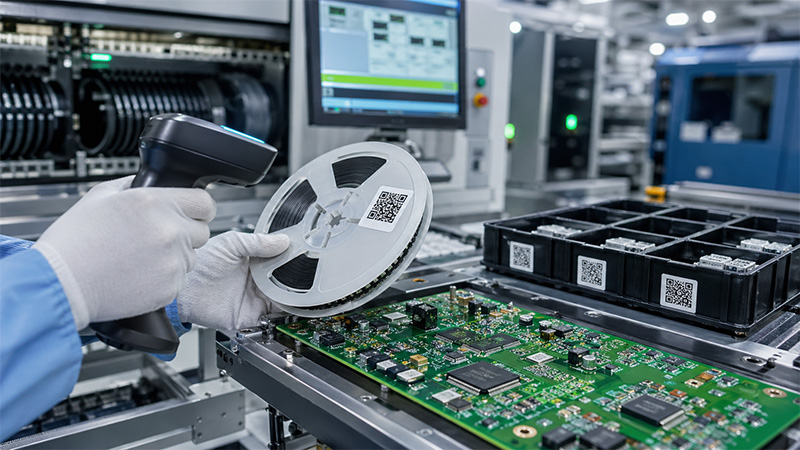
- Barcode/RFID Scanning at Receipt: Upon arrival, each reel, tray, or tube is scanned. Its barcode, which contains the supplier and manufacturer data, is linked in our inventory system to the specific purchase order and its associated certificates.
- Reel & Tray Management in SMT: Our high-speed Yamaha pick-and-place machines are fed from reels and trays whose IDs are validated by the programming software before production begins. This ensures the correct part is loaded for the specific BOM.
- In-Line Verification: Vision systems on the placement machines can perform a final check on component markings (like value and date code) before placement, adding another layer of verification.
- Lot Control & Kitting: For a given work order, components are kitted from specific, logged lots. This “lot locking” ensures that if an anomaly is later found in a component batch, every board built from that kit can be precisely identified.
Table: Tracking Methods vs. Component Packages
| Component Package | Primary Tracking Method | Challenge & Solution |
|---|---|---|
| Reels (SMDs like 0402, 0603) | Barcode on reel. System logs usage per board. | Reel splitting mid-job. Solution: Our MES creates a new, unique log for the partial reel. |
| Trays (BGAs, QFNs, PGAs) | Tray ID barcode. Each pickup is logged. | Tray mixing. Solution: Dedicated trolleys and scan-verified loading procedures. |
| Tubes/Bulk (ICs, Connectors) | Bag/Lot barcode. Weighed or counted issuance. | Manual handling errors. Solution: Barcode-scan at the kitting station before issuance to production. |
| Loose Parts (Wire, Hardware) | Lot-controlled inventory issued per work instruction. | Lack of unique ID. Solution: Strict first-in-first-out (FIFO) and lot segregation in storage. |
For specialized assemblies like Ceramic PCB Assembly for Educational Equipment or Wire Harness PCB Assembly, tracking extends beyond SMDs. The specific ceramic substrate lot (e.g., 96% Al2O3) and the wire gauge/specification are similarly logged. This meticulous approach is crucial because a fault in a high-reliability substrate or a custom wire can be as critical as a faulty IC. Our stable supply chain and direct sourcing from authorized distributors provide a reliable foundation for this verifiable tracking from the very origin of the component.
How Can Digital Systems Improve Traceability in the PCB Assembly Process?
Manual tracking with paper travelers is prone to error, loss, and delay. Digital systems are the engine of modern end-to-end visibility, transforming traceability from a static record into a dynamic, analytical tool.
Digital traceability, typically via a Manufacturing Execution System (MES), delivers transformative improvements:
- Real-Time Data Capture: As a board moves through the line—from solder paste printing to final test—machines automatically feed data (e.g., “Board SN-12345 passed AOI at Station 3, 14:22”) into the central system. This eliminates manual entry lag and errors.
- Automated Alerts & Control: The system can enforce process rules. For example, it can prevent a board from proceeding to reflow if the solder paste inspection (SPI) step failed, or flag a board if a component from a quarantined lot is mistakenly scanned.
- Instant Traceability Reports: Instead of compiling paper records, a complete history for any serial number or batch can be generated in seconds. This is invaluable during audits or failure investigations.
- Big Data Analytics for Process Optimization: By aggregating data across thousands of boards, manufacturers can identify subtle correlations—for example, linking a specific reflow profile parameter to a slight increase in voiding for a particular BGA package.
- Enhanced Supply Chain Transparency: Digital systems can integrate with supplier portals, allowing for automated verification of component authenticity and compliance documentation, creating a seamless digital thread from the component manufacturer to the finished product.
For the customer, this means you’re not just receiving a batch of boards; you’re receiving a comprehensive digital dossier for that batch. When we provide a 12L FR4 PCB Assembly for Communications, we can also provide a digital report showing the exact Rogers material lot used, the impedance test results for each controlled line, and the functional test log for every unit. This level of transparency builds unparalleled trust and simplifies compliance with standards like ISO 13485 (medical devices) or IATF 16949 (automotive), certifications that Best Technology holds.
How Does Traceability Support Defect Analysis and Product Recall Management?
When a defect occurs, time is critical. A robust traceability system shifts the investigation from a lengthy, blame-shifting detective story to a rapid, forensic science with precise answers. This capability is the ultimate validation of a PCB assembly technology partner’s maturity.
Defect Analysis: From Weeks to Hours
Without traceability, finding the root cause of a field failure might require testing hundreds of boards and interviewing production staff. With a digital traceability system, the process is reversed:
- Isolate: Input the failing board’s serial number.
- Retrieve: The system instantly retrieves the complete build record: all component lot numbers, the specific SMT line and head used, the reflow profile ID, the operator, and all test results.
- Correlate: The system can then identify all other boards (by serial number) that share any of the same unique parameters—e.g., “all boards using Component Lot #ABC123 from Reflow Profile #7 on Line 2.”
- Analyze: Engineers can now focus their analysis on this targeted subset, dramatically accelerating root cause identification, whether it’s a bad component lot, a marginally out-of-spec oven zone, or a placement misalignment.
Recall Management: Precise, Targeted, and Cost-Effective
The financial and reputational cost of a recall is monumental. Poor traceability forces a “shotgun” approach—recalling the entire month’s production. Effective traceability enables a “sniper” approach.
- Scenario: A capacitor from a specific supplier lot is found to have a high early failure rate.
- Without Traceability: Must recall all products assembled during the entire time period that capacitor was in inventory, potentially tens of thousands of units.
- With Best Technology’s Traceability: We query our system to identify every board (by customer and serial number) that contains a capacitor from that exact defective lot. The recall is limited to perhaps a few hundred specific units. This precision saves millions in logistics, replacement, and brand damage.
Our quality assurance process, which includes over 9 comprehensive testing stages from AOI to X-ray, generates the data. Our traceability system makes that data actionable, turning quality control from a cost center into a strategic asset for risk mitigation.
What Traceability Documents Should a PCB Assembly Manufacturer Provide?
The proof of traceability is in the documentation delivered with your order. These documents are your legal and technical assurance of quality and compliance. A professional manufacturer should provide a comprehensive package that tells the full story of your product’s build.
Essential Traceability Documents Include:
- Certificate of Conformity (CoC): A formal declaration that the product meets all specified requirements, including the relevant standards (e.g., RoHS, UL). It should reference the specific purchase order and batch.
- Traceability Report (or Build History Report): This is the core document. It should list, at a minimum:
- Customer Name/PO Number/Project Code
- Unique Board Serial Numbers or Lot/Batch Number
- PCB Fabrication Data (Material, Finish, Thickness)
- List of Critical Components with Manufacturer Name and Lot/Date Codes
- Key Process Sign-offs (SMT, Wave Soldering, Conformal Coating)
- Test and Inspection Reports:
- AOI Report: Summary and images of any flagged defects.
- X-Ray Inspection Report: For BGAs and hidden joints, highlighting voiding percentage and solder joint integrity.
- ICT/FCT Data Log: Functional test results, showing pass/fail status and measured values for key test points.
- Material Certifications:
- PCB Material Certs: For specialized substrates (e.g., Rogers, ceramic).
- Solder Paste Cert: Proof of alloy composition and compliance.
- Component Certs: Copies of CoCs from distributors for critical ICs.
- First Article Inspection Report (FAIR): For new projects or significant changes, a detailed report verifying that the first units produced meet all design and performance specifications.
At Best Technology, we consider this documentation suite a standard deliverable, not an optional extra. Whether you receive a prototype PCB Assembly or a full production run of complex Rigid-flexible PCBs, the accompanying paperwork provides the end-to-end visibility you need for your own quality systems and regulatory submissions.
How to Choose a PCB Assembly Partner with Strong Traceability Control?
Selecting a contract manufacturer is a major decision. Strong traceability is a key indicator of a mature, reliable, and low-risk partner. Here are critical factors to evaluate:
Evaluation Checklist for Traceability Capability:
- Ask About Their System: Do they use a paper-based traveler or a digital MES? A modern MES is essential for real-time, error-free tracking.
- Request Sample Documentation: Ask to see redacted examples of the traceability and test reports they provide. Assess the level of detail—does it show component lot codes linked to serial numbers?
- Probe Their Component Sourcing: How do they ensure component authenticity? Partners who source primarily from authorized distributors (like Best Technology, which uses Digikey, Mouser, Avnet, Arrow) have a more verifiable and secure supply chain than those relying on the open market.
- Inquire About Defect Resolution: Pose a scenario: “If we find a faulty component in the field, how would you identify all affected boards and the root cause?” Their answer should clearly describe a process using serial/lot tracking to isolate the issue swiftly.
- Verify Certifications: Certifications like IATF 16949 (Automotive) and ISO 13485 (Medical Devices) have stringent traceability requirements. A certified manufacturer’s systems have been audited and validated by a third party.
- Assess Their Process Control: Traceability is meaningless without controlled processes. Do they document and control solder profiles, stencil designs, and machine programs? This data must be part of the traceability record.
- Consider Their Scale and Flexibility: Can their system handle both high-mix, low-volume prototype work (where every board may be unique) and high-volume runs? A good system scales its tracking granularity appropriately.
A partner like Best Technology, with 20 years of experience and a full suite of certifications, embeds these controls into our culture. Our all-inclusive service model means traceability isn’t an add-on; it’s integrated into our PCB assembly process from the initial component sourcing to the final box build and shipment. We provide the online WIP updates so you have visibility every step of the way.
Electronics Assembly Traceability Requirements are the foundation of trust, quality, and accountability in modern manufacturing. This guide has detailed how comprehensive tracking of components, processes, and data provides the end-to-end visibility necessary to manage risk, ensure compliance, and build superior products.
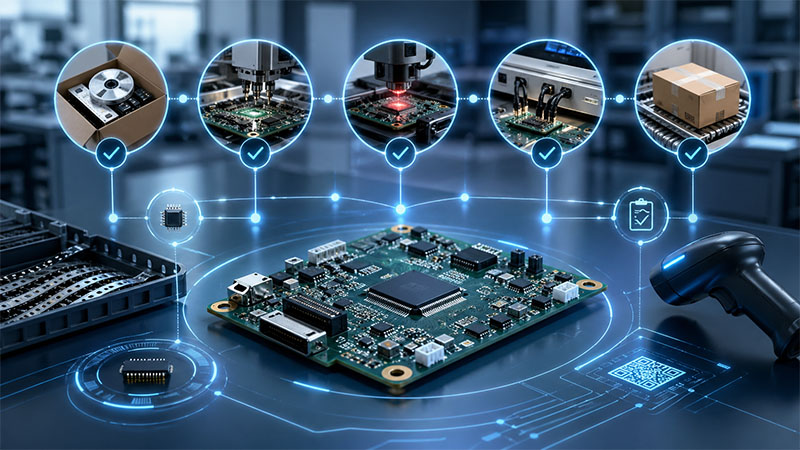
To put it in a nutshell, electronics Assembly Traceability Requirements are the foundation of trust, quality, and accountability in modern manufacturing. This guide has detailed how comprehensive tracking of components, processes, and data provides the end-to-end visibility necessary to manage risk, ensure compliance, and build superior products.
Choosing a partner with weak traceability exposes your business to unnecessary risk. Choosing a partner like Best Technology provides the assurance that comes from complete transparency. As a certified one-stop PCBA expert with two decades of experience, we don’t just assemble boards; we deliver fully documented, traceable solutions you can rely on. Pls feel free to contact us today for a traceable, high-quality PCB assembly solution via sales@bestpcb.vn.
FAQs About Electronics Assembly Traceability Requirements
1. What are the primary standards for electronics assembly traceability?
The most widely recognized standard is IPC-1782, which establishes the requirements for traceability in printed board assembly manufacturing. It defines different levels of traceability—ranging from basic lot tracking to critical, component-level data—depending on the sector (e.g., commercial, medical, or aerospace). Other critical frameworks include ISO 13485 for medical devices and AS9100 for the aerospace industry, both of which mandate rigorous record-keeping for every component and process step.
2. What is the difference between “Lot” and “Unit” level traceability?
- Lot Traceability: Tracks a group of components or boards that were manufactured under the same conditions. It is useful for identifying issues in specific production batches.
- Unit (Serial) Traceability: Assigns a unique identifier to every single PCB. This allows manufacturers to track the exact history of an individual board, including which specific operator handled it, which machine it passed through, and the precise timestamp of each assembly phase.
3. Why is traceability critical in PCB assembly?
Traceability acts as a “flight recorder” for electronics manufacturing. Its primary functions include:
- Recall Mitigation: If a component is found to be defective, traceability allows a manufacturer to recall only the specific units affected rather than an entire product line.
- Counterfeit Prevention: It ensures that every component used is sourced from authorized distributors, preventing the entry of “gray market” or substandard parts.
- Process Improvement: By analyzing the data, engineers can identify which machines or processes are causing recurring defects.
4. What data points must be recorded for full traceability compliance?
To meet comprehensive traceability requirements, the following data points are typically captured in a Manufacturing Execution System (MES):
- Component Data: Manufacturer name, part number, date code, and lot code.
- Process Data: Solder paste inspection (SPI) results, reflow oven temperature profiles, and Automated Optical Inspection (AOI) logs.
- Personnel & Tooling: ID of the technician, specific feeder used on the SMT machine, and the software version loaded onto the board.
Quick Reference: Traceability Levels
| Level | Focus | Typical Application |
| Level 1 | Basic Lot/Batch | Consumer Electronics |
| Level 2 | Critical Component Tracking | Automotive / Industrial |
| Level 3 | Full Unit-Level History | Medical / Aerospace / Defense |