 language
 english


What is a Chip on Film? Chip on Film VS Chip on Glass
Have you ever wondered how modern slim devices like smartphones and OLED TVs achieve narrow bezels and high performance If you’re curious about the technology that connects display chips to flexible substrates you’ve likely heard of chip on film but do you know what it really is how it works and how it differs from other similar technologies This blog breaks down everything you need to know about chip on film from its structure and working principle to its applications repair costs and key comparisons helping you gain a clear understanding of this essential electronics component.
What is a Chip on Film?
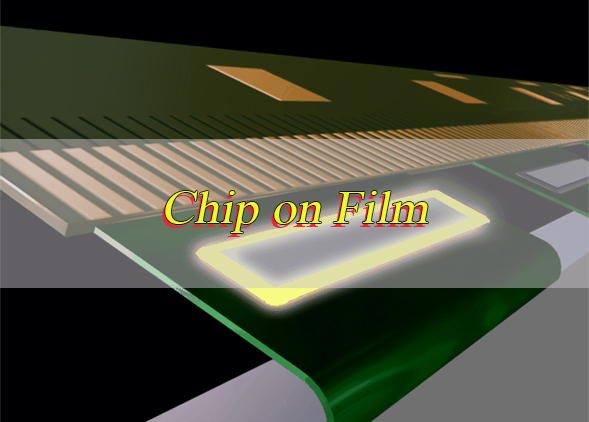
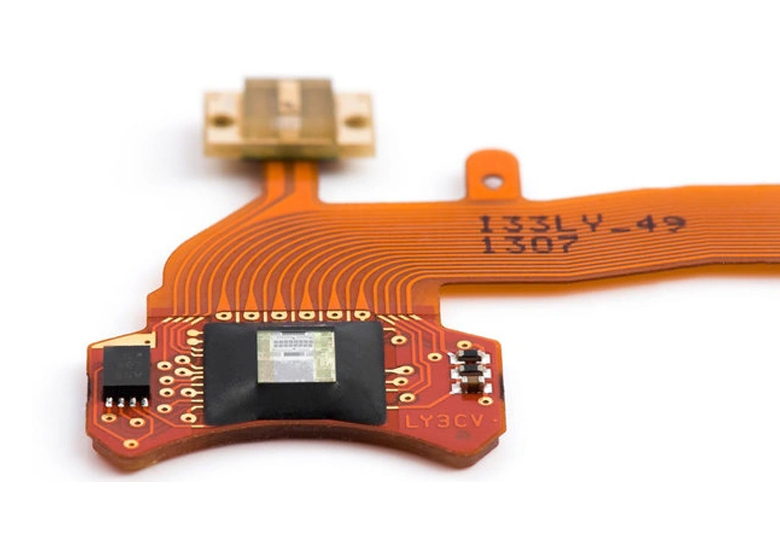
Chip on film also known as COF is a advanced packaging technology that bonds a bare integrated circuit chip directly onto a flexible film substrate. Unlike traditional packaging methods that use rigid boards COF uses flexible materials like polyimide to create a thin lightweight and bendable connection between the chip and the device’s main circuitry. This technology is critical for miniaturizing electronic devices and improving signal transmission efficiency.
COF eliminates the need for bulky wire bonds or rigid carriers making it ideal for devices that require slim designs and high-density packaging. It integrates the chip and flexible substrate into a single component simplifying assembly and reducing the overall size of electronic products. As a key part of display and consumer electronics manufacturing chip on film has become indispensable in modern technology.
What is Structure of Chip on Film?
A typical chip on film structure consists of four core components each playing a vital role in its functionality. Understanding these components helps you grasp how COF works and why it’s suitable for specific applications.
- Flexible Substrate: The base of the chip on film usually made of polyimide a material known for its high heat resistance flexibility and electrical insulation. This substrate acts as the carrier for the chip and conductive circuits allowing the entire COF component to bend without damaging internal connections.
- Conductive Circuits: Thin copper lines etched onto the flexible substrate these circuits transmit electrical signals between the chip and the device’s main board. The circuits are designed with ultra-fine line widths and spacing often as small as 35μm to support high-density signal transmission and reduce signal loss.
- Chip (IC Die): The bare integrated circuit chip is the core of the COF. It is directly bonded to the flexible substrate using advanced bonding techniques eliminating the need for a separate packaging case. The chip can be a display driver IC touch controller or other specialized chips depending on the application.
- Bonding Layer: A thin layer of anisotropic conductive film (ACF) or other bonding materials that secures the chip to the flexible substrate and ensures electrical continuity between the chip’s bumps and the substrate’s circuits. This layer also protects the connection from moisture and physical damage.
How Does Chip on Film Technology Work?
Chip on film technology works by creating a direct electrical and mechanical connection between a bare chip and a flexible substrate enabling efficient signal transmission and flexible integration into electronic devices. The process relies on precise bonding and circuit design to ensure reliability and performance.
First the flexible substrate is manufactured with etched copper circuits that match the chip’s input/output (I/O) pads. The chip is then flipped upside down so its bumps align with the substrate’s circuits. A bonding layer such as ACF is applied between the chip and substrate. Heat and pressure are applied to activate the bonding layer causing the conductive particles in the ACF to connect the chip’s bumps to the substrate’s circuits forming a secure electrical connection.
Once bonded the COF component can be bent or folded to fit into tight spaces within devices. The flexible nature of the substrate allows the chip to be placed in areas that rigid packaging cannot reach while the direct bonding reduces signal delay and interference making chip on film ideal for high-speed data transmission in modern electronics.
What is the Purpose of a Chip on Film?
The primary purpose of chip on film is to provide a compact flexible and high-performance packaging solution for integrated circuit chips especially in devices where space is limited and flexibility is required. It addresses key challenges in modern electronics manufacturing including miniaturization signal integrity and assembly efficiency.
Chip on film reduces the overall size of chip packaging by eliminating bulky casings and wire bonds allowing manufacturers to create slimmer devices like smartphones tablets and OLED TVs with narrow bezels. It also improves signal transmission by minimizing the distance between the chip and the device’s main circuitry reducing signal loss and interference.
Additionally COF simplifies the assembly process by integrating the chip and flexible substrate into a single component reducing the number of parts and assembly steps. This lowers manufacturing costs and improves production efficiency while enhancing the reliability of the final product.
What is Chip on Film Used for?
Chip on film is widely used in electronic devices that require slim designs flexible integration and high-performance signal transmission. Its applications span consumer electronics display technology and industrial equipment with the most common uses listed below.
Display Devices: The most common application of chip on film is in display panels including LCD OLED and AMOLED screens. COF is used to bond display driver ICs to the flexible edges of the screen enabling narrow bezels and slim designs. It is found in smartphones tablets laptops TVs and smartwatches.
Flexible Electronics: COF is essential for flexible devices such as foldable smartphones and wearable technology. Its flexible substrate allows the chip to bend with the device without breaking connections making it ideal for products that require repeated folding or bending.
Consumer Electronics: Beyond displays chip on film is used in digital cameras camcorders and portable music players. It provides a compact packaging solution for control chips and signal processors reducing the size and weight of these devices.
Industrial Equipment: In industrial settings COF is used in small form factor sensors and control modules where space is limited and reliability is critical. It is also used in medical devices such as portable monitors and diagnostic equipment.
What is the Chip on Film Process?
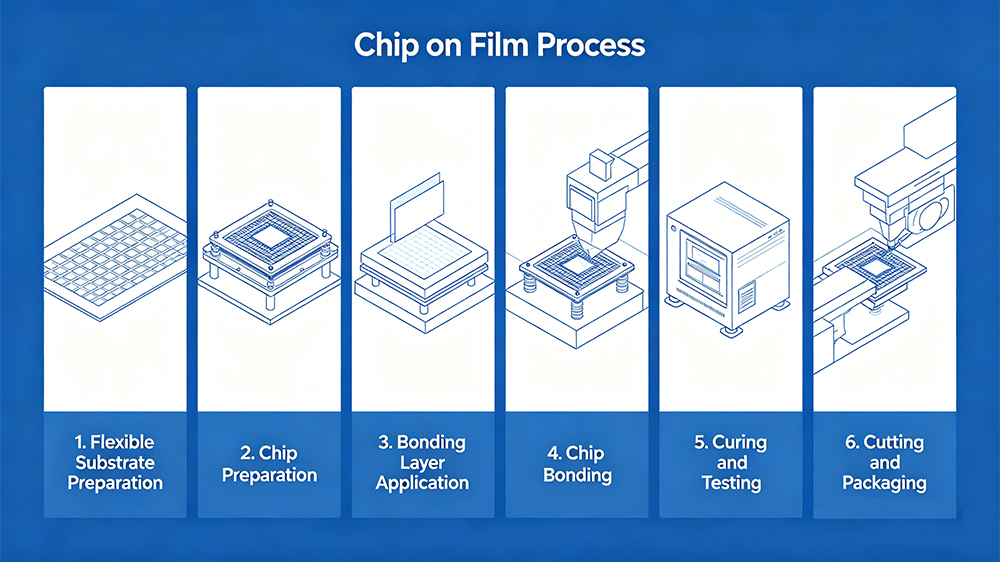
The chip on film process involves several precise steps to ensure the chip is securely bonded to the flexible substrate and the final component meets performance standards. The process is divided into six key stages each requiring careful control and quality checks.
1. Flexible Substrate Preparation: The process starts with manufacturing the flexible substrate usually from polyimide. The substrate is cleaned and treated to improve adhesion then copper is deposited and etched to create the required conductive circuits. The circuits are designed to match the chip’s I/O pads with ultra-fine line widths to support high-density connections.
2. Chip Preparation: The bare IC chip is tested to ensure it meets performance specifications. The chip’s surface is cleaned and its bumps are prepared for bonding. The bumps are small metal projections that will connect to the substrate’s circuits.
3. Bonding Layer Application: Anisotropic conductive film (ACF) is applied to the flexible substrate. ACF contains tiny conductive particles embedded in a resin matrix which will form electrical connections when heat and pressure are applied.
4. Chip Bonding: The chip is aligned with the substrate’s circuits using precision equipment. Heat and pressure are applied to the assembly activating the ACF. The conductive particles in the ACF are compressed between the chip’s bumps and the substrate’s circuits forming a secure electrical connection. The resin in the ACF cures to provide mechanical stability.
5. Curing and Testing: The bonded COF component is cured at a controlled temperature to ensure the bonding layer is fully set. The component is then tested for electrical continuity signal transmission and mechanical strength to identify any defects.
6. Cutting and Packaging: The finished COF components are cut to the required size and packaged for shipment to device manufacturers. The components are often rolled onto reels for automated assembly into final products.
What is the Difference Between Chip on Film and Chip on Glass? (COF VS COG)
Chip on film and Chip on Glass (COG) are both packaging technologies used to bond chips to substrates but they differ in substrate type flexibility and application. The table below clearly outlines their key differences to help you choose the right technology for your needs.
| Comparison Factor | Chip on Film (COF) | Chip on Glass (COG) |
|---|---|---|
| Substrate Material | Flexible polyimide film substrate | Rigid glass substrate |
| Flexibility | Highly flexible can be bent folded or twisted without damage | Rigid cannot be bent or folded |
| Bezel Size | Enables extremely narrow bezels ideal for slim devices | Bezels are wider as the chip occupies space on the glass |
| Signal Transmission | Low signal loss due to direct bonding and short connection paths | Slightly higher signal loss compared to COF |
| Applications | Foldable devices smartphones OLED TVs wearables | Traditional LCD displays budget smartphones basic tablets |
| Cost | Higher cost due to flexible substrate and precise bonding | Lower cost simpler manufacturing process |
| Reliability | High reliability resistant to physical stress and vibration | Prone to damage from physical stress due to rigid substrate |
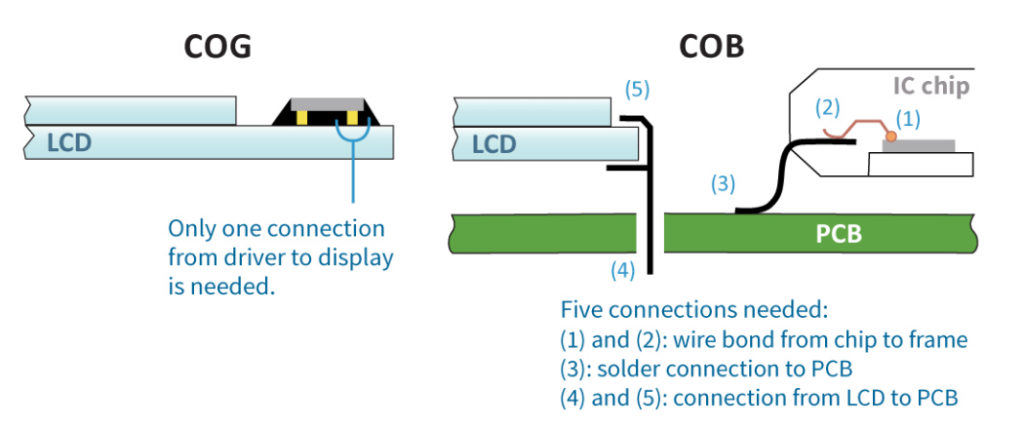
What is the Difference between Chip on Film and Chip on Board? (COF VS COB)
Chip on Film (COF) and Chip on Board (COB) are two distinct packaging technologies with different substrate types applications and performance characteristics. The table below details their key differences to help you understand when to use each.
| Comparison Factor | Chip on Film (COF) | Chip on Board (COB) |
|---|---|---|
| Substrate Material | Flexible polyimide film | Rigid printed circuit board (PCB) |
| Flexibility | Highly flexible suitable for bendable devices | Rigid cannot be bent |
| Packaging Size | Very compact thin and lightweight | Larger and bulkier due to rigid PCB |
| Bonding Method | Direct bonding using ACF or eutectic bonding | Wire bonding or flip chip bonding then encapsulated in black glue |
| Heat Dissipation | Moderate heat dissipation due to flexible substrate | Better heat dissipation due to rigid PCB and encapsulation |
| Applications | Displays foldable devices wearables | LED lighting power supplies industrial control boards |
| Repair Complexity | Difficult to repair requires specialized equipment | Easier to repair compared to COF |
How Much Does Chip on Film Cost?
Chip on film cost ranges from $0.50 to $25 per unit, depending on application, substrate material, circuit density and order volume. Key cost factors include flexible substrate type, circuit complexity, integrated IC and bonding technology. Note that 2026 has seen price increases for some advanced materials used in high-end COF.
- Low-Cost COF ($0.50–$3 per unit): For basic devices (low-end smartphones, simple LCDs), using standard polyimide substrates and basic bonding materials, ideal for mass production.
- Mid-Range COF ($3–$12 per unit): For mainstream devices (mid-range phones, OLED TVs), with fine circuits and advanced bonding. Large orders (100,000+ units) can reduce costs by 15%–25%.
- High-End COF ($12–$25+ per unit): For specialized devices (foldable phones, medical equipment), with ultra-precise circuits and high-performance substrates. Custom/small-batch orders may exceed $25.
Can Chip on Film Be Repaired?
Yes, chip on film can be repaired but the feasibility depends on the type and severity of the damage. Contrary to common misconceptions COF damage is not always irreversible and many minor issues can be fixed with the right equipment and expertise.
Minor damage such as chip misalignment contact oxidation or loose bonding can be repaired. Repair technicians use specialized tools to reflow the chip clean the contacts or reapply the bonding layer. These repairs are relatively quick and cost-effective especially for devices where replacing the entire display or component is expensive.
Severe damage such as a broken flexible substrate a burnt chip or torn circuits is more difficult to repair. In these cases the COF module must be replaced with a new one. However replacement is only feasible if the exact COF module is available for the device model. For older or less common devices finding a replacement COF module may be challenging making repair impossible.
It’s important to note that COF repair requires specialized equipment and expertise. Most general repair shops do not have the tools or knowledge to repair chip on film and you may need to seek out a specialized electronics repair service.
FAQ About Chip on Film Technology
Q1: Is chip on film the same as flexible PCB?
A1: No, chip on film is not the same as flexible PCB. A flexible PCB is a flexible circuit board used to connect components while chip on film is a packaging technology that bonds a bare chip directly to a flexible substrate. COF includes a flexible substrate but also integrates the chip and bonding layer making it a complete packaging solution rather than just a circuit board.
Q2: Can chip on film be used in high-temperature environments?
A2: Yes, chip on film can be used in high-temperature environments. The polyimide substrate used in COF has high heat resistance typically withstanding temperatures up to 260°C. This makes COF suitable for applications such as industrial equipment and automotive electronics where high temperatures are common.
Q3: How long does a chip on film component last?
A3: A chip on film component typically lasts 5 to 10 years depending on the application and usage conditions. In consumer electronics like smartphones and TVs COF components can last the lifetime of the device if not subjected to physical damage. In industrial settings where devices are exposed to harsh conditions the lifespan may be shorter.
Q4: Is chip on film better than COG for foldable devices?
A4: Yes, chip on film is better than COG for foldable devices. COF uses a flexible substrate that can bend and fold without breaking while COG uses a rigid glass substrate that cannot be bent. This flexibility makes COF the only viable option for foldable smartphones and other bendable devices.
Q5: Can I repair chip on film damage at home?
A5: No, you cannot repair chip on film damage at home. COF repair requires specialized equipment such as precision bonding tools and heat presses as well as expertise in chip bonding. Attempting to repair COF at home will likely cause further damage to the component or the device.
Q6: What causes chip on film failure?
A6: The most common causes of chip on film failure are physical damage such as bending or dropping the device heat damage from overheating poor bonding during manufacturing and moisture damage. Physical damage is the most frequent cause especially in portable devices like smartphones.
Q7: Is chip on film used in OLED displays?
A7: Yes, chip on film is widely used in OLED displays. COF is used to bond the display driver ICs to the flexible edges of OLED screens enabling narrow bezels and slim designs. It is a critical component in modern OLED smartphones TVs and wearables.