 language
 english


What is electronic contract manufacturing?
Electronic contract manufacturing is when a company outsources the production of electronic products or assemblies to a specialized manufacturer. The manufacturer may handle PCB fabrication, component sourcing, PCB assembly, testing, inspection, and final packaging.
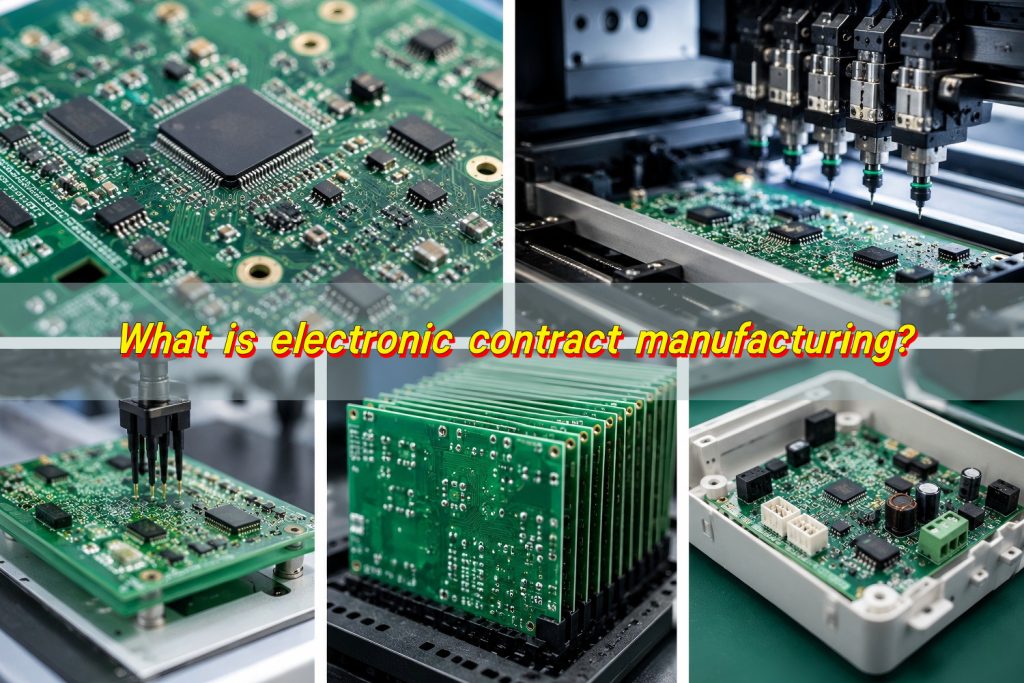
What exactly does electronic contract manufacturing cover?
Electronic contract manufacturing is a business model where a company outsources part or all of its electronics production to a specialized manufacturing partner. Instead of building every product in its own factory, the brand owner, product developer, OEM, or startup works with an experienced electronics manufacturing partner to handle PCB fabrication, component sourcing, PCB assembly, testing, inspection, packaging, and sometimes final product integration.
In practical terms, electronic contract manufacturing covers much more than “assembling parts.” A capable electronics contract manufacturer can support the whole journey from an early engineering prototype to stable mass production. This may include design review, DFM checking, BOM optimization, material selection, PCB stack-up suggestions, SMT assembly, through-hole assembly, conformal coating, functional testing, box build, repair analysis, and logistics coordination.
In the PCB and PCBA field, electronic contract manufacturing usually starts with engineering files. These may include Gerber files, ODB++ files, BOM, CPL/PNP file, schematic, assembly drawing, test requirements, and mechanical drawings. Once the files are reviewed, the manufacturer can check manufacturability, confirm component availability, prepare a quote, and suggest improvements before production starts.
The main coverage usually includes the following areas:
- PCB fabrication, including rigid PCB, flexible PCB, rigid-flex PCB, HDI PCB, ceramic PCB, aluminum PCB, and high-frequency PCB.
- Component procurement, including passive parts, ICs, connectors, sensors, power devices, and approved alternates.
- PCB assembly, including SMT, DIP, mixed technology, fine-pitch assembly, BGA assembly, and selective soldering.
- Testing and inspection, including AOI, X-ray, ICT, flying probe, functional testing, burn-in, and visual inspection.
- Value-added services, including conformal coating, potting, cable assembly, box build, labeling, packaging, and shipment support.
Best Technology works mainly in PCB and PCBA manufacturing, so this type of service is especially relevant for customers who need both circuit board production and assembly support from one coordinated supplier. When PCB fabrication and PCBA assembly are handled together, communication becomes smoother. Engineering issues can be solved earlier.
That is why electronic contract manufacturing is widely used by engineering teams that want flexibility, technical support, and reliable output without building their own full production facility. It combines manufacturing infrastructure with practical engineering experience, and this combination is very valuable for modern electronic products.
What industries rely on electronic contract manufacturing most?
Many industries rely on electronic contract manufacturing because electronic control, sensing, communication, and power management are now part of nearly every advanced product. From medical monitors to industrial controllers, from automotive modules to smart home devices, the demand for well-built PCBs and PCB assemblies continues to grow.
Medical electronics is one of the most important areas. Devices such as patient monitors, diagnostic equipment, wearable health devices, infusion systems, imaging equipment, and laboratory instruments need dependable PCB assemblies. These products often require careful documentation, component traceability, clean assembly practices, and strict process control.
Automotive electronics is another strong application area. Modern vehicles contain many electronic modules, including body control modules, battery management systems, lighting modules, sensors, infotainment systems, radar modules, charging systems, and power control units. These products often face vibration, temperature changes, moisture, and long service-life expectations. PCB layout, solder joint quality, material selection, and inspection standards all matter.
Industrial control is also highly dependent on electronics contract manufacturing. PLC modules, motor drivers, HMI panels, power supplies, automation controllers, robotics control boards, and monitoring equipment all need stable PCB and PCBA production. Industrial products are often produced in medium batches with long product lifecycles. This means the manufacturer must be able to support repeat orders, component alternates, repair feedback, and engineering change management.
Consumer electronics also uses this model, especially for smart devices, IoT products, lighting control, audio devices, chargers, home automation products, and portable electronics. These projects often need fast sampling, flexible production, cost control, and attractive product integration. A turnkey EMS provider can help reduce sourcing workload and speed up launch schedules.
Telecommunication and networking products also rely heavily on contract electronics manufacturing. Routers, gateways, RF modules, base station boards, antenna modules, optical communication boards, and high-speed network equipment may need controlled impedance, low-loss materials, HDI design, fine-pitch SMT assembly, and advanced testing. In these projects, PCB fabrication knowledge and assembly experience must work together.
Aerospace, defense-related commercial electronics, and high-reliability control systems also use electronic contract manufacturing, but these sectors usually require more documentation, more process discipline, and more qualification steps. A supplier for these projects should understand traceability, controlled production, inspection records, and stable material sourcing.
| Industry | Typical Electronic Products | What Customers Usually Need |
|---|---|---|
| Medical electronics | Patient monitors, diagnostic boards, wearable devices, lab instruments | Traceability, reliable assembly, clean process control, documentation |
| Automotive electronics | Control modules, BMS boards, lighting boards, sensors | Thermal stability, vibration resistance, long lifecycle support |
| Industrial control | PLCs, motor drivers, power boards, automation controllers | Durable PCB assemblies, repeatable production, repair feedback |
| Consumer electronics | IoT devices, smart home products, chargers, audio products | Fast prototyping, cost control, flexible volume production |
| Telecom and networking | RF boards, routers, gateways, communication modules | Impedance control, low-loss materials, high-speed assembly |
| Energy and power systems | Inverters, chargers, battery systems, power control boards | Heavy copper, thermal management, strong soldering quality |
| Aerospace-related electronics | Control boards, sensor modules, communication boards | High reliability, traceability, process documentation |
For Best Technology, PCB and PCBA projects often come from industrial, medical, automotive, communication, power electronics, and high-reliability product teams. These customers usually value engineering communication as much as production capacity.
Electronic contract manufacturing is useful because each industry has its own technical pressure points. Medical products value reliability and records. Automotive products value durability and process stability. Industrial products value long-term repeatability. Telecom products value signal integrity. Power electronics value thermal control and copper design.
Does EMS support both prototype and mass production?
Yes, EMS can support both prototype and mass production, but the working method is different at each stage. Prototype production is usually about design verification, fast learning, and early problem discovery. Mass production is more about consistency, yield, cost control, documentation, and delivery stability. A reliable electronic contract manufacturing partner should understand both sides.
During prototyping, the manufacturer should not treat the project as a simple order. It should check the BOM, footprint, polarity markings, component package, PCB panel design, solder mask clearance, via design, impedance requirements, thermal areas, test points, and assembly process. Good feedback at this point can save a lot of time later.
For mass production, the focus changes. The product design is usually more stable, and the EMS provider needs to build a repeatable production process. This includes approved materials, controlled process parameters, production fixtures, inspection plans, testing procedures, packaging methods, and quality records. The manufacturer may also create work instructions, first article reports, test records, and production traceability data.
| Stage | Main Purpose | Typical Quantity | Manufacturer’s Main Role |
|---|---|---|---|
| Prototype | Validate design and function | 1–50 pcs | Fast build, DFM feedback, early issue detection |
| Engineering sample | Improve manufacturability | 10–200 pcs | Process review, BOM check, assembly optimization |
| Pilot production | Confirm production readiness | 100–1,000 pcs | Fixture setup, test plan, yield tracking |
| Mass production | Stable repeat orders | 1,000+ pcs | Quality control, cost optimization, delivery stability |
Best Technology supports customers who need PCB fabrication and PCB assembly from prototype to production. This is helpful for companies that want a single supplier to understand both the bare board and the assembled board. When an issue appears during assembly, the team can quickly check whether it comes from PCB design, PCB fabrication tolerance, component selection, soldering profile, stencil design, or handling process.
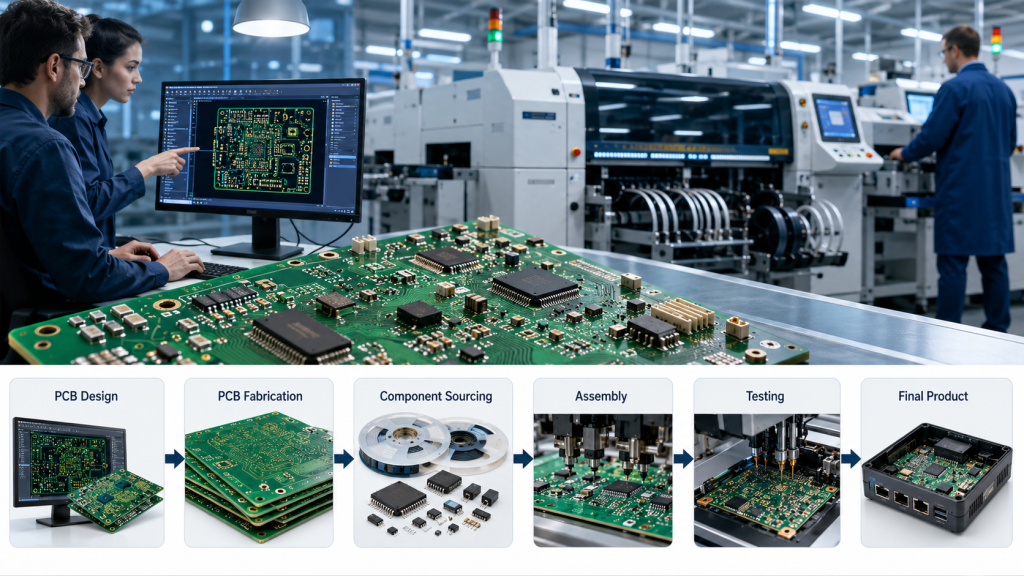
EMS is not limited to one production size. It can support one-off samples, small-batch production, medium-volume manufacturing, and continuous mass production. The real question is whether the manufacturer has the right technical strength, production discipline, and communication system for the customer’s product type.
What’s included in full service electronic contract manufacturing?
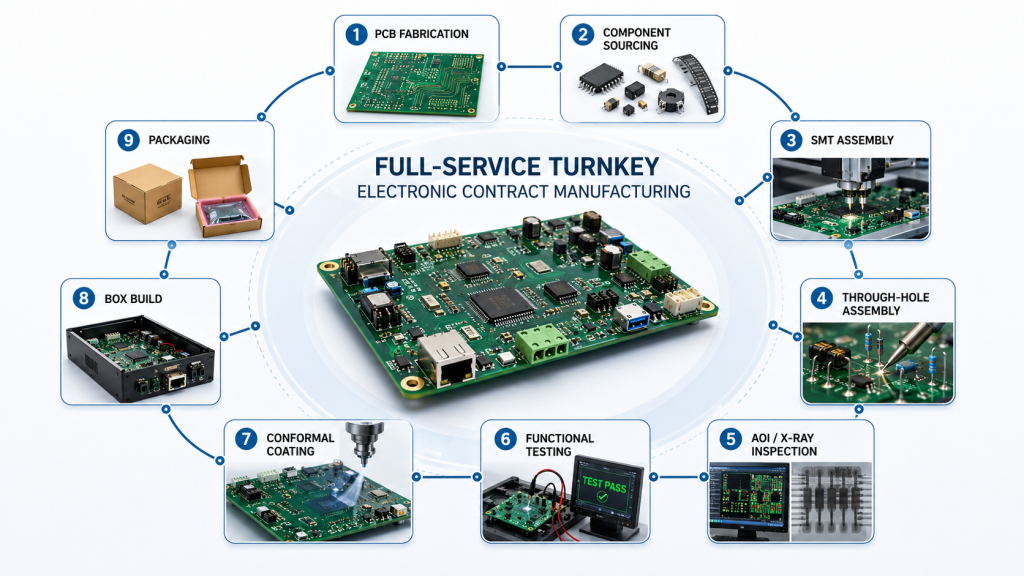
Full service electronic contract manufacturing usually means that the supplier can manage a complete production package instead of only one isolated process. For many customers, this is the most convenient way to produce an electronic product because the manufacturer coordinates PCB fabrication, component sourcing, assembly, inspection, testing, packaging, and sometimes final product integration.
A full service EMS model often starts with engineering review. The manufacturer checks whether the PCB design and assembly files are complete and suitable for production. This step may include DFM review, DFT review, BOM checking, panelization suggestions, component lifecycle review, footprint verification, and test point review.
PCB fabrication is another important part. Depending on the product, the board may be a standard FR4 PCB, high-TG PCB, HDI PCB, rigid-flex PCB, aluminum PCB, copper base PCB, ceramic PCB, Rogers high-frequency PCB, or heavy copper PCB.
Component procurement is also a major part of full service electronic contract manufacturing services. The EMS provider can source resistors, capacitors, ICs, connectors, relays, sensors, transformers, switches, and other parts based on the customer’s BOM.
PCB assembly includes SMT assembly, through-hole assembly, mixed assembly, BGA placement, fine-pitch component assembly, reflow soldering, wave soldering, selective soldering, hand soldering for special parts, and cleaning if required.
Inspection and testing are also part of full service EMS. AOI can check solder joints and component placement. X-ray can inspect hidden solder joints under BGAs and QFNs. Flying probe and ICT can check electrical connections.
Full service EMS may also include value-added manufacturing. This can involve conformal coating, potting, cable assembly, harness installation, mechanical assembly, enclosure integration, labeling, serial number tracking, firmware programming, packaging, and shipment preparation. In some projects, this is called box build assembly.
A typical full service package may include:
- Engineering file review and DFM feedback.
- PCB fabrication and process selection.
- Component sourcing and BOM optimization.
- SMT and through-hole PCB assembly.
- AOI, X-ray, ICT, flying probe, and functional testing.
- Firmware programming, coating, potting, and box build if needed.
- Packaging, labeling, documentation, and logistics support.
For customers, the value of full service electronic contract manufacturing is coordination. Instead of managing separate suppliers for PCB, components, assembly, testing, and packaging, the customer can work with one team. This reduces communication time and helps avoid blame-shifting when issues occur. It also gives the manufacturer a full view of the product, which often improves engineering decisions.
Best Technology specializes in PCB and PCBA, so its role fits well into full service electronics manufacturing projects. The company can support customers from board fabrication to assembly, with attention to material selection, manufacturability, inspection, and practical engineering communication. For customers building medical, industrial, automotive, power, communication, or smart electronic products, this integrated approach can make the production process cleaner and easier to manage.
Is turnkey EMS a good fit for new electronic projects?
Turnkey EMS is often a very good fit for new electronic projects, especially when the customer wants to reduce coordination work and move faster from design to production. In a turnkey model, the electronics contract manufacturer handles most production-related tasks, including PCB fabrication, component procurement, assembly, inspection, and testing. The customer provides design files and project requirements, while the EMS partner manages the manufacturing execution.
For new product development, this can be highly useful. A new project often has many moving parts. The engineering team may still be confirming the circuit, mechanical structure, firmware, user interface, certification requirements, and market schedule. At the same time, someone must source components, compare PCB options, check lead times, organize assembly, and solve production issues. Turnkey EMS brings these tasks together.
One major advantage is speed. A manufacturer that already has PCB production knowledge, assembly capability, sourcing channels, and inspection resources can prepare the build more efficiently. It can also identify problems early. For example, if the BOM contains an obsolete part, the EMS partner can suggest alternates. If the PCB design creates assembly challenges, the engineering team can receive feedback before production starts.
Another advantage is cost visibility. A turnkey EMS provider can review the complete cost structure, not only the PCB price or assembly price. It can check whether a component is unusually expensive, whether the PCB stack-up is more complex than necessary, whether a package is difficult to assemble, or whether a design choice increases inspection cost. This helps customers make practical decisions early.
Turnkey EMS is also helpful for customers who do not have a large purchasing team or production engineering team. Startups, small companies, R&D groups, and overseas OEMs often prefer this model because it gives them access to manufacturing experience without building a complete internal factory system.
However, turnkey EMS works best when communication is clear. The customer should provide complete files, approved specifications, expected quantity, testing requirements, target application, and any critical design notes. The EMS provider should also communicate clearly about lead time, component availability, process concerns, cost drivers, and production risks.
| Project Situation | Is Turnkey EMS Suitable? | Reason |
|---|---|---|
| New prototype with limited sourcing resources | Yes | The EMS partner can handle PCB, components, and assembly together |
| Product with many special components | Yes | Procurement and alternates can be managed more efficiently |
| High-reliability industrial or medical board | Yes | Testing, traceability, and process control can be planned early |
| Customer wants to control every purchased part internally | Sometimes | Consigned or hybrid sourcing may be more suitable |
| Very simple board with local parts already prepared | Sometimes | Partial assembly service may be enough |
| Product moving from sample to production | Yes | Lessons from prototypes can support pilot and mass production |
Best Technology can support turnkey PCB and PCBA projects for customers who want one coordinated manufacturing partner. This is useful when the project requires PCB fabrication, component purchasing, SMT assembly, DIP assembly, testing, and engineering feedback. For overseas customers, working with a coordinated PCB and PCBA supplier can make the communication path shorter and clearer.
Can China electronic contract manufacturing save production cost?
China electronic contract manufacturing can help many companies save production cost, but the real value is not only lower labor cost. The bigger advantage often comes from mature supply chains, PCB manufacturing depth, component sourcing networks, flexible production capacity, engineering experience, and complete assembly ecosystems. When these factors work together, customers can often achieve better total project efficiency.
China has a strong electronics manufacturing base. Many PCB factories, SMT assembly houses, component distributors, metal parts suppliers, cable suppliers, enclosure suppliers, testing service providers, and logistics companies operate close to each other. This concentration can shorten communication time and reduce coordination cost. It also gives customers more options for materials, production processes, and price levels.
For PCB and PCBA projects, cost is affected by many details. Board size, layer count, material type, copper thickness, surface finish, hole size, impedance control, solder mask color, component package, assembly density, testing method, and order quantity all influence the final price. A China-based electronic contract manufacturer with strong PCB and PCBA knowledge can help customers review these details and find a more balanced solution.
For example, a product may not need an expensive material if standard high-TG FR4 can meet the thermal requirement. A PCB may be redesigned slightly to improve panel utilization. A difficult-to-source component may be replaced with an approved alternate. A test fixture may reduce testing time during repeated production. These improvements can make a meaningful difference over the full product lifecycle.
The cost-saving potential usually appears in several areas:
- PCB fabrication efficiency through mature process options and panel optimization.
- Component sourcing flexibility through broad supplier networks.
- Assembly cost control through SMT automation and stable production lines.
- Engineering improvement through DFM and BOM optimization.
- Logistics coordination through integrated export experience.
- Lower management cost by reducing the number of separate suppliers.
It is useful to compare direct price and total cost. Direct price is the visible quote. Total cost includes engineering time, supplier communication, rework, delays, component shortages, quality issues, testing time, packaging, and logistics. A professional EMS partner should help customers reduce total cost, not only offer a low unit price.
| Cost Area | How China EMS Can Help | Practical Result |
|---|---|---|
| PCB production | Wide material and process options | Better cost-performance balance |
| Component sourcing | Access to broad supply channels | Faster quotation and alternate options |
| Assembly | Automated SMT and skilled production teams | Efficient production and stable output |
| Engineering review | DFM, BOM, and process suggestions | Fewer avoidable production problems |
| Testing | Integrated inspection and functional test support | Better delivery confidence |
| Supply coordination | PCB, PCBA, and packaging handled together | Lower communication workload |
Best Technology supports customers with PCB and PCBA manufacturing in China and Vietnam, which can give customers more flexibility in production planning. For companies that need prototype builds, medium-batch assembly, or continuous production, this structure can help balance cost, quality, and delivery needs. The value is not only in manufacturing price, but also in engineering response and coordinated service.
How to choose a reliable electronic contract manufacturing company?
Choosing a reliable electronic contract manufacturing company requires more than checking the lowest quote. A good supplier should have technical capability, process control, clear communication, stable sourcing, inspection resources, and experience with your product category. The right partner should understand your product goals and help you manufacture with confidence.
The first step is to check whether the supplier’s capabilities match your product. A simple two-layer consumer board and a high-density medical PCB assembly do not need the same level of process control. If your product needs HDI, rigid-flex, high-frequency materials, heavy copper, ceramic substrates, BGA assembly, conformal coating, or functional testing, the supplier must prove that it can handle those requirements.
The second step is to review engineering support. A reliable electronics contract manufacturer should be able to check your Gerber files, BOM, CPL file, stack-up, surface finish, solder mask design, component spacing, test points, and special process notes. Good DFM feedback is a strong sign that the supplier understands real production, not only quotation.
The third step is quality control. Ask what inspection and testing methods are available. AOI, X-ray, ICT, flying probe, functional testing, and visual inspection all serve different purposes. For high-reliability products, you may also need traceability, first article inspection, process records, material reports, or production test data.
The fourth step is supply chain management. Component sourcing can strongly affect schedule and cost. A reliable EMS company should check BOM risk, lead time, lifecycle status, packaging requirements, and alternate parts. It should also communicate clearly when a part is unavailable, expensive, or risky.
The fifth step is communication. This is often underestimated. A good EMS partner should respond clearly, ask useful questions, explain production concerns, and keep records organized. Smooth communication saves time and reduces misunderstandings, especially when the customer and manufacturer are in different countries.
When comparing suppliers, consider these points:
- Does the company have PCB fabrication and PCBA assembly experience?
- Can it support your board type, component package, and testing needs?
- Does it provide DFM feedback before production?
- Are quality certifications and process controls suitable for your industry?
- Can it manage component sourcing and alternates responsibly?
- Does it support prototypes, pilot runs, and mass production?
- Are quotations clear, with cost drivers explained?
- Is communication professional, fast, and technically useful?
A comparison table can help customers evaluate suppliers more clearly.
| Evaluation Point | What to Check | Why It Matters |
|---|---|---|
| PCB capability | Layer count, materials, copper, surface finish, impedance | Confirms whether the supplier can build the bare board correctly |
| Assembly capability | SMT, DIP, BGA, fine pitch, mixed assembly | Confirms whether the supplier can assemble the board reliably |
| Testing resources | AOI, X-ray, ICT, flying probe, functional test | Improves product confidence before shipment |
| Engineering support | DFM, BOM review, stack-up advice | Helps prevent avoidable production problems |
| Quality system | Certifications, traceability, inspection records | Supports stable and repeatable manufacturing |
| Supply chain | Sourcing channels, alternates, lifecycle checks | Reduces component risk and schedule pressure |
| Communication | Response speed, technical clarity, documentation | Makes international cooperation much easier |
| Scalability | Prototype, pilot, volume production | Supports product growth over time |
Best Technology can be considered by customers looking for PCB and PCBA support with engineering communication. The company’s strength is in circuit board manufacturing and PCB assembly, including a range of PCB technologies and turnkey assembly services. For customers who need one partner to review files, build bare boards, source components, assemble boards, and support testing, this type of integrated service can be very practical.
Is EMS suitable for medical and automotive electronic products?
EMS is suitable for medical and automotive electronic products when the manufacturer has the right quality system, technical capability, process control, documentation habits, and experience with high-reliability electronics. These two industries have demanding expectations, so the EMS partner must be selected carefully. When the match is right, electronic contract manufacturing can support both product quality and efficient production.
Medical electronic products often require stable performance, clean assembly practices, traceable materials, and reliable documentation. A PCB assembly used in a patient monitor, diagnostic device, wearable health product, or laboratory instrument may need tighter control than a standard consumer board. The EMS provider should understand inspection records, component traceability, process validation, and functional testing.
For medical PCB and PCBA projects, the manufacturing partner should pay attention to material quality, solder joint reliability, contamination control, labeling, serialization, and documentation. If the product requires regulatory submission, the customer may also need organized manufacturing records. While the OEM is usually responsible for final product compliance, the EMS partner can provide important production support.
Automotive electronics also fits well with EMS, especially when the manufacturer understands long lifecycle support, thermal stress, vibration exposure, power management, and stable process control. Automotive boards may be used in lighting systems, battery management, sensors, control modules, charging systems, displays, and communication modules. These products often need durable materials, strong soldering, careful inspection, and consistent production.
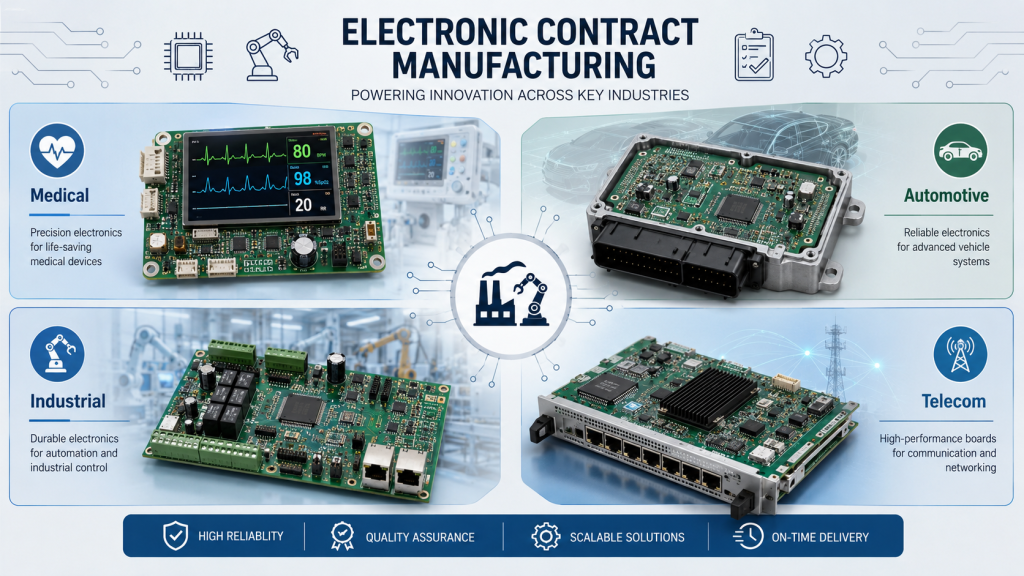
The requirements for medical and automotive products are not identical, but they share some similar manufacturing priorities. Both value reliability, repeatability, traceability, and disciplined process control. Both benefit from early DFM review and strong communication between the customer and the manufacturer.
| Requirement | Medical Electronics | Automotive Electronics |
|---|---|---|
| Main priority | Patient safety, reliability, documentation | Durability, thermal stability, long service life |
| Common products | Monitors, diagnostic boards, wearable devices | Control modules, BMS, lighting boards, sensors |
| PCB focus | Clean layout, stable materials, traceability | Thermal design, vibration resistance, robust copper design |
| Assembly focus | Controlled soldering, inspection, functional test | Process repeatability, solder joint strength, inspection |
| Documentation | Traceability, test records, process data | Production records, quality control, lifecycle support |
| Testing | Functional test, AOI, X-ray, burn-in when needed | AOI, X-ray, ICT, functional and reliability-related tests |
EMS can support these industries in several ways. First, it gives customers access to mature production equipment and trained assembly teams. Second, it helps turn engineering designs into repeatable manufacturing processes. Third, it can provide inspection and testing data that support quality confidence. Fourth, it can help manage component sourcing and production continuity.
For medical and automotive projects, early communication is especially important. The customer should explain the application environment, reliability expectations, testing requirements, cleanliness needs, traceability requirements, and target production volume. The EMS provider should review whether the PCB design, materials, components, and assembly process are suitable for that use.
Best Technology supports PCB and PCBA manufacturing for customers in medical, automotive, industrial, communication, and power electronics fields. Its PCB and assembly knowledge can help customers select suitable board materials, review manufacturability, manage PCB fabrication, assemble components, and organize inspection. For projects that need higher reliability, this integrated PCB and PCBA support can make production more controlled and easier to manage.
In summary, electronic contract manufacturing gives companies a practical way to produce electronic products with professional PCB, PCBA, sourcing, assembly, testing, and manufacturing support. It is useful for prototypes, pilot runs, and mass production, and it can serve industries such as medical, automotive, industrial control, telecom, energy, and consumer electronics. For customers who need reliable PCB and PCBA support, Best Technology can provide integrated manufacturing assistance from board fabrication to assembly. For project discussion or quotation support, please contact sales@metal-domes.com.