 language
 english


How Does a Bluetooth Transmitter Work? A Complete Technical Guide
How does a Bluetooth transmitter work — and why does something so small do something so useful? You plug in a tiny device. Suddenly, your wired TV sends audio to wireless headphones across the room. Or your old car stereo plays music from your phone. That small device is doing quite a lot, and this guide explains every part of it.
We will walk through the full process — from radio signals and pairing to codecs, latency, and specific use cases like FM transmitters in cars and Bluetooth adapters for TV. We will also explain what goes inside the circuit board that makes all of it possible.
Best Technology is a professional one-stop PCB and PCBA manufacturer based in Vietnam. We have been making circuit boards for 20 years, serving engineers and companies across the wireless electronics, consumer audio, medical, and automotive industries. That last part — the circuit board inside every Bluetooth transmitter — is at the heart of what we do. If you are developing a Bluetooth device and need a reliable manufacturing partner, we would love to help.
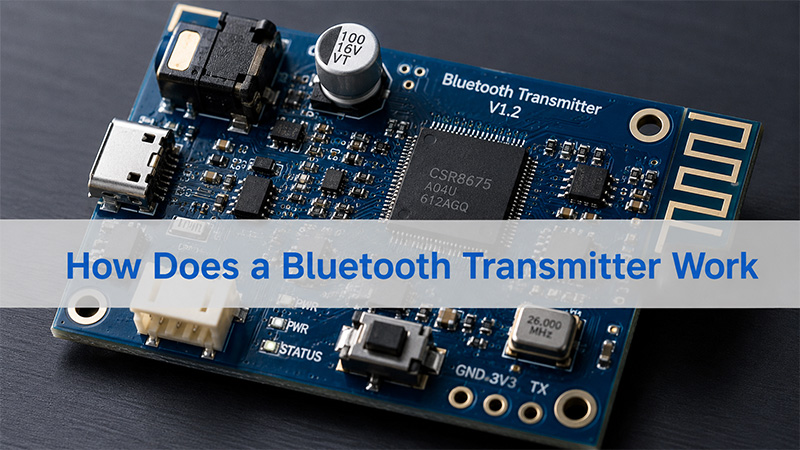
What Is a Bluetooth Transmitter?
A Bluetooth transmitter is a device that takes an audio or data signal and sends it wirelessly to a paired receiver. It does this using short-range radio waves in the 2.4 GHz frequency band.
In simple terms, it converts a wired or digital signal into a wireless Bluetooth stream. The receiver on the other end — headphones, a speaker, or a car stereo — picks up that stream and plays it back.
It is worth noting the difference between a transmitter and a receiver. A Bluetooth receiver takes a wireless signal and converts it into a wired or analog output. A transmitter does the opposite. It takes a wired source and makes it wireless. In practice, however, many devices combine both functions. You can switch them between modes depending on what you need.
How Does a Bluetooth Transmitter Work? The Core Process
Understanding how a Bluetooth transmitter works means looking at four steps. Each step is fast — the whole cycle takes milliseconds — but each one has a specific job.
Step 1: Signal Input
First, the transmitter receives an input signal. This might come from a 3.5mm audio jack, an optical (TOSLINK) port, an RCA connector, or a USB audio source. Some transmitters also accept digital audio directly from a device’s Bluetooth chip. In that case, the audio never leaves the wireless domain at all.
Step 2: Analog-to-Digital Conversion
Next, if the input is analog — such as from a 3.5mm jack — the transmitter converts it to a digital signal. An ADC (analog-to-digital converter) built into the circuit handles this. It samples the audio thousands of times per second. Each sample is encoded as a binary number. The result is a stream of digital audio data.
Step 3: Encoding and Packetization
After that, the Bluetooth chip encodes the digital audio using a codec — such as SBC, aptX, or AAC. The codec compresses the data to reduce bandwidth. Then the compressed data is split into small packets. Each packet carries a header with sequence information, a destination address, and error-checking data.
Step 4: Radio Transmission
Finally, the Bluetooth radio module transmits those packets over the 2.4 GHz ISM band. Bluetooth uses a technique called frequency hopping spread spectrum (FHSS). This means the signal hops between 79 different radio channels, changing up to 1,600 times per second. As a result, interference from Wi-Fi, microwaves, and other 2.4 GHz devices is greatly reduced.
The receiver then does the reverse. It reassembles the packets in order, decodes the audio codec, converts the data back to analog, and outputs it to a speaker or headphone driver.
In short: a Bluetooth transmitter takes a signal, digitizes it if needed, compresses it with a codec, splits it into packets, and fires it out over hopping radio channels at 2.4 GHz.
How Bluetooth Pairing Works?
Before a transmitter can send data, it must pair with a receiver. This pairing process creates a secure, encrypted link between the two devices. It only needs to happen once. After that, most devices remember each other and reconnect automatically.
Discovery
First, the transmitter enters discoverable mode. It broadcasts its presence by sending short advertising packets. The receiver scans for these packets and lists the device in its Bluetooth menu.
Authentication
Then the user confirms the connection — often by pressing a button or entering a PIN. On modern devices using Secure Simple Pairing (SSP), no PIN is needed. Instead, the devices authenticate each other using a public-key cryptography exchange.
Key Exchange and Bonding
Next, the devices exchange a link key. This key is stored in both devices’ memory. It encrypts all future communications. The devices are now bonded — they recognize each other and skip the full pairing process on future connections.
Profile Negotiation
Finally, the devices agree on which Bluetooth profile to use. For audio, that is A2DP (Advanced Audio Distribution Profile). This profile defines how high-quality stereo audio is streamed from transmitter to receiver. Other profiles — such as HFP for phone calls or AVRCP for remote control — may also be set up at the same time.
Codecs and Audio Quality in Bluetooth Transmitters
The codec determines how audio is compressed before it is sent. This directly affects sound quality, compatibility, and delay. Not all transmitters support all codecs. In fact, the codec used is always determined by what both the transmitter and receiver support — whichever is the highest quality they share in common.
| Codec | Bitrate | Latency | Notes |
|---|---|---|---|
| SBC | Up to 345 kbps | 100–200 ms | Baseline codec; supported by all Bluetooth devices |
| AAC | Up to 320 kbps | 60–120 ms | Preferred by Apple devices; good quality |
| aptX | 352 kbps | ~70 ms | Qualcomm codec; better quality than SBC |
| aptX HD | 576 kbps | ~70 ms | 24-bit audio; for audiophile use |
| aptX LL | 352 kbps | <40 ms | Low-latency version; good for video sync |
| LDAC | Up to 990 kbps | ~80 ms | Sony codec; highest quality over Bluetooth |
In practice, SBC is available everywhere but gives the lowest quality. For TV use, aptX LL is the best choice because its delay is low enough to keep audio in sync with video. For pure sound quality, LDAC or aptX HD are better options — but both devices must support the same codec for it to work.
How Does a Bluetooth FM Transmitter Work in a Car?
A Bluetooth FM transmitter in a car solves a simple problem. Many older car stereos have no Bluetooth input. However, every car stereo has an FM radio. So the FM transmitter bridges that gap — and it does so using two separate radio systems working together.
Receiving Audio via Bluetooth
First, your phone pairs with the FM transmitter over standard Bluetooth. The transmitter’s built-in Bluetooth radio receives the audio stream from your phone using the A2DP profile. This is the same profile used by any Bluetooth speaker.
Converting Bluetooth to an FM Signal
Next, the transmitter decodes the Bluetooth audio and converts it back to an analog signal. Then, a built-in FM modulator rebroadcasts that analog signal as a low-power FM radio transmission. You choose the frequency — typically an unused one in your area, such as 88.1 or 107.9 MHz.
Car Stereo Receives the Signal
Finally, your car stereo picks up this local FM broadcast. It decodes the FM signal and plays the audio through your car speakers. From the stereo’s point of view, it is receiving a regular radio station. In reality, that station is broadcasting from a device plugged into your car’s USB port.
There is one limitation worth knowing. FM radio is limited to a bandwidth of about 15 kHz. That is lower than the full range of Bluetooth audio. So the sound quality from an FM transmitter is slightly reduced compared to a direct Bluetooth connection. In addition, performance depends on finding a clean FM frequency. In busy cities with many stations, that can be harder to do.
Engineer’s note: the FM modulator circuit inside a Bluetooth FM transmitter is a separate sub-system from the Bluetooth radio. Both must be carefully designed on the PCB to prevent cross-interference between the two radio systems running at the same time.
How Does a Bluetooth Transmitter Work for TV?
A Bluetooth TV transmitter lets you watch TV through wireless headphones or a Bluetooth speaker — no cable needed. This is especially useful for late-night viewing without disturbing others, or for people who need louder audio than the TV speakers can provide.
Connecting to the TV
The transmitter plugs into the TV’s audio output. The best option depends on what your TV offers:
- Optical (TOSLINK) — highest quality digital audio; use this when available
- 3.5mm headphone jack — analog output; simple and widely supported
- RCA connectors — analog output; common on older TVs
- USB — powers the transmitter; audio still comes via optical or 3.5mm
Transmitting the Audio
Once connected, the transmitter captures the TV audio and streams it to paired headphones or speakers. For TV watching, latency matters more than it does for music. Audio that lags even 80ms behind the picture looks noticeably out of sync to most people. So a transmitter with aptX LL — which keeps delay under 40ms — is the right choice for TV use.
By contrast, standard SBC transmitters introduce 100–200ms of delay. That level of lag is clearly visible when watching people speak on screen. This is why codec selection matters much more for TV than it does for listening to music alone.
Bluetooth Transmitter Latency: What to Expect
Latency is the time between audio leaving the source and arriving at the listener’s ears. For music, small amounts of latency are unnoticeable. For TV and video, however, even modest delays cause visible lip-sync problems.
Several factors add to the total latency of a Bluetooth transmitter:
- Codec processing time — encoding and decoding take time; complex codecs take longer
- Buffering — both transmitter and receiver hold data in a buffer to handle packet loss; larger buffers mean more delay
- Retransmission — when packets are dropped due to interference, resending them adds more time
- Distance — over longer distances, signal quality drops and retransmissions increase
In practice, end-to-end latency for common codecs works out roughly as follows. SBC sits at 100–200ms and is not suitable for video. AAC is 60–120ms, which is marginal. aptX is 50–70ms and is acceptable for most people. aptX LL is 32–40ms, making it the best choice for video. LDAC is 70–90ms and is not optimized for low latency despite its high audio quality.
For music listening, anything under 100ms is fine. For TV watching, target a transmitter with aptX LL or one that is specifically rated as low-latency.
Bluetooth Transmitter Range and Signal Factors
Most consumer Bluetooth transmitters are Class 2 devices. In open air with no obstacles, they reach 10 to 30 meters. Class 1 devices can go up to 100 meters, but these are less common in everyday consumer products.
In real environments, however, range is always lower than in open air. Several things reduce it:
- Walls and furniture — concrete blocks signal significantly; drywall has less effect
- Interference — Wi-Fi, microwave ovens, and baby monitors all compete at 2.4 GHz
- Body obstruction — the human body absorbs 2.4 GHz signals, so a phone in your pocket can affect range
- Receiver sensitivity — the quality of the receiver’s antenna affects how well it picks up weaker signals
On the positive side, Bluetooth 5.0 and later versions improved range through higher power options and better modulation schemes. For typical home or office use within 10 meters, any modern Bluetooth 4.0 or later transmitter will perform reliably.
What’s Inside a Bluetooth Transmitter: The PCB
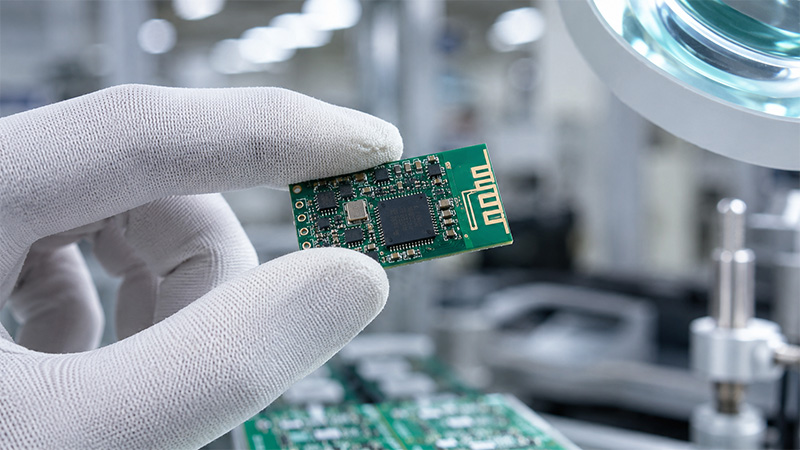
Every Bluetooth transmitter contains a printed circuit board assembly (PCBA). This is the hardware that makes all the wireless functionality possible. Understanding what is on that board helps explain why some transmitters work reliably at 20 meters while others drop out at 5.
Key Components on a Bluetooth Transmitter PCB
| Component | What It Does |
|---|---|
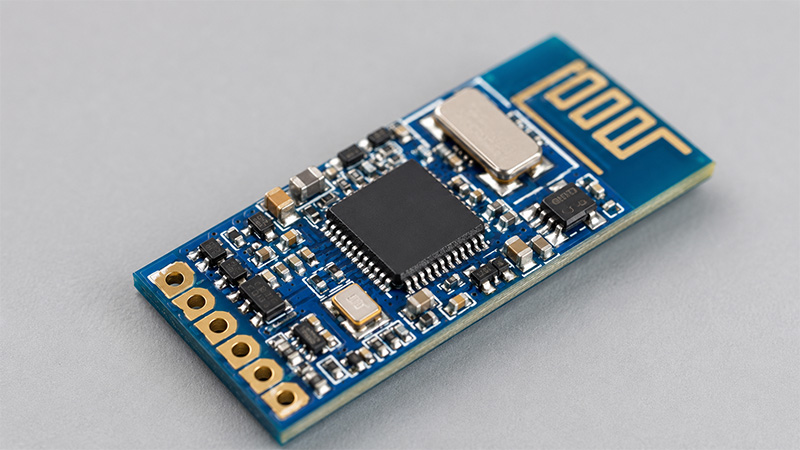
| Bluetooth SoC | The core chip. Handles the radio, protocol stack, codec, and pairing. Common options: Qualcomm CSR, Nordic Semiconductor, TI CC series. |
| RF Antenna | Sends and receives the 2.4 GHz signal. May be a PCB trace, chip antenna, or external whip on higher-power devices. |
| ADC | Converts analog audio input to digital data. Audio quality depends on ADC resolution and sampling rate. |
| Power Management IC | Regulates voltage for each circuit section. Poor regulation causes audio noise and RF interference. |
| Crystal Oscillator | Provides a precise clock for the Bluetooth radio. Frequency accuracy directly affects signal timing. |
| Decoupling Capacitors | Filter power supply noise near the SoC and RF section. Essential for clean signal separation. |
| Flash Memory | Stores firmware and paired device data. Determines how many devices the transmitter remembers. |
Why PCB Layout Matters for Bluetooth Performance
The layout of these components is just as important as the components themselves. In particular, the antenna needs a clear zone with no ground plane beneath it, or radiation efficiency drops sharply. The RF traces must be impedance-controlled — typically 50 ohms — or signal reflections will reduce range. The audio signal path and the RF path must be separated by ground planes to prevent cross-talk. And the power supply lines to the RF section need careful filtering, because switching noise from the power management IC can inject directly into the radio.
In other words, these are PCB design decisions. They are made before manufacturing begins. And they are the difference between a transmitter that works well and one that does not.
How Best Technology Manufactures Bluetooth Transmitter PCBs?
At Best Technology, we are a professional one-stop PCB and PCBA manufacturer based in Vietnam. We serve engineers and companies developing Bluetooth transmitters, wireless audio devices, IoT modules, and other electronics that need both reliable PCB fabrication and precise assembly.
Understanding how Bluetooth transmitters work — the RF layout, the codec architecture, the power management — is the kind of knowledge our team applies when reviewing customer designs before production. We catch problems at the design stage, where fixing them costs hours instead of weeks.
What We Offer for Bluetooth Transmitter Projects?
Every order is handled by a dedicated account manager and a three-person engineering team covering DFM, process, and quality. Before production starts, we deliver a formal DFM report and a BOM optimization list. For RF-heavy designs like Bluetooth transmitters, this review is especially important. Antenna clearance violations and impedance mismatches are common issues that our team identifies before any boards go into fabrication.
Our services for Bluetooth transmitter development include the following:
- PCB fabrication with controlled impedance — 50-ohm RF traces, ±10% tolerance
- SMT assembly for fine-pitch packages including QFN and BGA Bluetooth SoCs
- Component sourcing for Bluetooth chipsets from authorized distributors
- DFM pre-review covering antenna keepout zones, RF trace routing, and power decoupling
- Prototype and small-batch support — we actively serve engineers at R&D and validation stage
- 1.5-week PCBA turnaround from Gerber files to shipped, tested boards
Our Certifications
We hold ISO 9001, ISO 13485, IATF 16949, and AS9100D. For standard consumer Bluetooth electronics, ISO 9001 covers general quality management. For medical Bluetooth applications — such as wireless hearing aids — ISO 13485 applies. For automotive Bluetooth devices, IATF 16949 is the relevant standard. We are qualified for all three.
To discuss your project, pls feel free to contact our engineering team at sales@bestpcb.vn or call +84-827-237566. Send us your Gerber files and BOM, and we will return a DFM review and quote within 24 hours.
FAQs About a Bluetooth Transmitter
How does a Bluetooth transmitter work?
A Bluetooth transmitter takes an audio or data input, converts it to a digital stream if needed, and encodes it using a codec like SBC or aptX. Then it splits the data into packets and transmits them over 2.4 GHz radio using frequency hopping. The receiver reassembles the packets, decodes the audio, and outputs it. The whole process runs continuously in real time, with only a few milliseconds of processing at each stage.
How does a Bluetooth FM transmitter work in a car?
A car Bluetooth FM transmitter uses two radio systems at once. First, it receives audio from your phone via standard Bluetooth. Then it rebroadcasts that audio as a low-power FM signal on a frequency you choose. Your car stereo picks up this local FM signal exactly as it would any other station. Audio quality is limited by FM radio’s 15 kHz bandwidth, and clear performance depends on finding an unused frequency in your area.
How does a Bluetooth transmitter work for TV?
A TV Bluetooth transmitter connects to the TV’s audio output — optical, 3.5mm, or RCA. It captures the audio and streams it wirelessly to paired headphones or speakers. For TV use, low latency matters most. A transmitter with aptX LL keeps the delay under 40ms, which is below the threshold where most people notice audio-video mismatch. Standard SBC transmitters introduce 100–200ms of delay, which is clearly noticeable on screen.
What is the range of a Bluetooth transmitter?
Most consumer transmitters reach 10 to 30 meters in open space. In practice, walls, interference, and body obstruction reduce this. For typical home and office use within 10 meters, however, any modern Bluetooth 4.0 or later device performs reliably without issue.
Does a Bluetooth transmitter add latency?
Yes, all Bluetooth transmitters add some delay. SBC introduces around 100–200ms. aptX LL reduces this to under 40ms, which is acceptable for video watching. For music only, latency under 100ms is generally unnoticeable to most listeners.
Can a Bluetooth transmitter connect to multiple receivers at once?
It depends on the chipset. Some transmitters support multipoint connections or Bluetooth broadcast mode, which allows audio to go to two or more receivers simultaneously. Standard Bluetooth Classic transmitters, however, pair with one device at a time. Check the specific transmitter’s specification sheet for multipoint or broadcast support before buying.
What is inside a Bluetooth transmitter PCB?
The key components are a Bluetooth SoC (the main processor and radio chip), an RF antenna, an ADC for analog-to-digital conversion, a power management IC, a crystal oscillator, decoupling capacitors, and flash memory for firmware and pairing data. The layout of these components — especially the antenna design and RF trace routing — directly determines the transmitter’s range, signal quality, and reliability.
Can Best Technology manufacture Bluetooth transmitter PCBs in Vietnam?
Yes. Best Technology provides one-stop PCB fabrication and PCBA assembly for Bluetooth transmitters and wireless electronics. We support prototype, small-batch, and volume production with a 1.5-week turnaround. Contact us at sales@bestpcb.vn or +84-827-237566 for a DFM review and quote within 24 hours.